



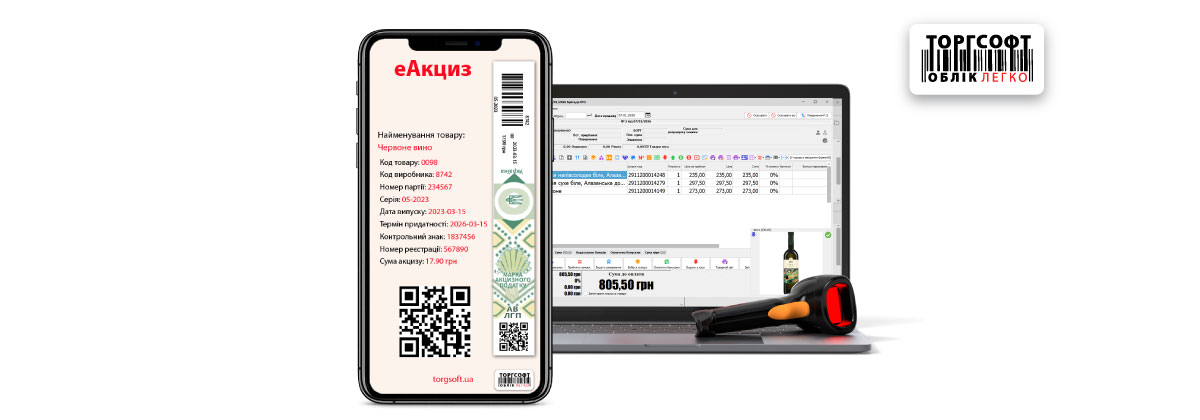
Ukraine is introducing eExcise, an electronic system for monitoring the circulation of alcoholic beverages, tobacco products, and liquids for electronic cigarettes. On October 13, 2026, the Verkhovna Rada adopted Bill No. 15532, which provides for postponing the mandatory launch of the system to July 1, 2027. Businesses holding the relevant licenses as of January 1, 2027, will have to register in eExcise by April 1, 2027. The bill also provides for a transition period for goods bearing paper excise stamps through December 31, 2028, and a special reduction in certain fines at the initial stage. For these changes to take effect, they must be signed by the President and officially published.
For manufacturers, importers, wholesalers, and retail stores, eExcise means new procedures for identifying, documenting, and tracking the movement of excisable goods. Manufacturers and importers will ensure electronic marking of products, suppliers will issue electronic excise documents, and sellers will work with new codes when receiving goods and processing payments through cash registers (РРО) or software cash registers (ПРРО). Businesses should already check their licenses, product documents, scanners, cash register equipment, accounting software, and staff readiness. Until the law postponing the launch takes effect, the dates set out in current Law No. 4698-IX remain legally binding.
When will eExcise launch, and what are the business deadlines?
The basic rules for electronic traceability were introduced by Law of Ukraine No. 3173-IX dated June 29, 2023. Later, Law No. 4698-IX moved the date for the system’s full launch to November 1, 2026.
The new Bill No. 15532, adopted by Parliament, provides for postponing this date by another eight months.
New eExcise implementation calendar
Date or period | What is provided for |
|---|---|
Through June 30, 2027 | Continued operation of the electronic system in test mode |
January 1–June 30, 2027 | Production operation of the system in test mode |
January 1–March 31, 2027 | Registration of economic operators holding the relevant licenses as of January 1, 2027 |
July 1, 2027 | Mandatory full use of eExcise |
July 1–December 31, 2027 | Application of a special rate for certain fines: 10% of the established sanction |
January 1–June 30, 2028 | Application of a special rate for certain fines: 30% of the established sanction |
Through and including December 31, 2028 | Period provided for the circulation of products bearing paper excise stamps, manufactured in Ukraine or imported into Ukraine’s customs territory before July 1, 2027 |
This is the calendar provided for in Bill No. 15532. Until it takes effect, the current deadlines apply, including the system launch on November 1, 2026, the possibility of circulating the relevant products bearing paper stamps until May 1, 2028, and the transition rules already established.
Therefore, Parliament’s adoption of the bill does not by itself change businesses’ legal obligations. The new deadlines will apply only when the law takes effect.
Official documents: Bill No. 15532, Law No. 4698-IX.
What is eExcise, and how does an electronic excise stamp work?
eExcise is a state electronic system that will maintain records of and trace the circulation of alcoholic beverages, tobacco products, and liquids for electronic cigarettes that are subject to excise marking.
The legal basis for the system is established by the Tax Code of Ukraine and Law No. 3817-IX.
The main change is the move to electronically identifying each individual unit of the relevant products.
What an electronic stamp will look like
An electronic excise tax stamp is a set of data contained in the state electronic system. Its graphic element is applied to the product as a two-dimensional DataMatrix code.
Under the Tax Code, the first 12 characters of the unique identifier, readable by people, must also be applied alongside the graphic element.
Distinguish between:
- An electronic excise stamp: information about a specific product unit in the state system.
- A DataMatrix code: a graphic representation of the stamp’s unique identifier on the packaging.
- A unique group identifier: a code used to identify the relevant grouped product packaging.
DataMatrix makes it possible to identify a product as it moves from the manufacturer or importer to the end consumer.
The graphic marking must meet the technical requirements approved by Cabinet of Ministers of Ukraine (КМУ) Resolution No. 890 dated July 16, 2025. In particular, clause 11 of the Procedure sets the minimum acceptable DataMatrix print quality: grade 2 under ISO/IEC 15415 or grade B under ISO/IEC 29158.
Therefore, the standard product barcode a store uses to look up the price and product name does not replace the electronic excise stamp.
Which goods require electronic excise marking?
eExcise covers three main product groups that are required by law to be marked:
Category | Examples |
|---|---|
Alcoholic beverages | Vodka, cognac, whisky, liqueurs, and other alcoholic beverages subject to excise marking |
Tobacco products | Cigarettes, cigars, cigarillos, and other relevant tobacco products |
Liquids for electronic cigarettes | Liquids that fall within the relevant excisable category and are subject to marking |
However, not all alcoholic beverages and not all excisable goods need to be marked with electronic excise stamps.
For current paper marking, clause 226.6 of the Tax Code requires alcoholic beverages with an ethyl alcohol content above 8.5% by volume to be marked, except for the cases listed in clause 226.10. Alcoholic beverages manufactured in Ukraine with an ethyl alcohol content of up to and including 8.5% are not marked. For electronic marking, the future wording of clause 226.10 of the Tax Code expressly exempts alcoholic beverages with an ethyl alcohol content of up to 8.5% by volume, regardless of country of manufacture. This rule will apply once the relevant changes take effect; the other exceptions in this clause must also be taken into account.
For example, ordinary beer does not need to be automatically included in electronic stamp tracking just because it is an excisable good. The statutory exceptions for certain types of wine products must likewise be taken into account.
Separate rules also apply to products intended for duty-free shops and other categories defined by the Tax Code.
Whether a product belongs to a marked category is determined by its characteristics, its code under the Ukrainian Classification of Goods for Foreign Economic Activity (УКТ ЗЕД), and the requirements of Article 226 of the Tax Code in the version applicable to the relevant marking procedure.
Source: Tax Code of Ukraine, Articles 215 and 226.
Who must register in eExcise?
Under the current calendar, Article 57 of Law No. 3817-IX provides for registration from November 1, 2026, of business entities that manufacture, import, or sell goods subject to electronic excise marking at wholesale or retail. Bill No. 15532 provides for a broader rule: holders of at least one of the licenses listed in the bill for manufacturing alcoholic beverages, tobacco products, or liquids for electronic cigarettes; for wholesale or retail trade in these products; or for trade in cider and perry without added alcohol will have to register. Under the bill, the registration obligation will depend on whether the relevant license is held, even if the specific goods are not subject to marking. The new rule will apply only after the relevant provisions of the law take effect.
Accordingly, eExcise applies to:
- Manufacturers of alcoholic beverages, tobacco products, and relevant liquids.
- Importers of these products.
- Wholesale suppliers and distributors.
- Retail stores.
- Other business entities involved in the circulation of goods subject to electronic marking.
However, each participant has different obligations.
Manufacturers and importers will ensure the creation and use of electronic stamps. Wholesalers will document product movements. Retail sellers will have to ensure proper receipt, tracking, and sale of marked goods.
Registration through the electronic cabinet
Cabinet of Ministers of Ukraine Resolution No. 1142 sets out how the electronic system operates and how access to it is organized.
To participate in electronic circulation, an economic operator must arrange registration, identify authorized representatives, and use the electronic interaction tools provided by the system.
Businesses should prepare in advance:
- up-to-date registration details for an individual entrepreneur (ФОП) or legal entity;
- current licenses for the relevant types of activity;
- information about retail locations, warehouses, and other sites;
- qualified electronic signatures for authorized persons;
- details of employees who need access to the system;
- software compatible with the electronic interaction tools provided.
To test system features, use the eExcise electronic cabinet.
Bill No. 15532 provides for three registration deadlines for holders of the licenses listed in it:
- if at least one relevant license is valid at 00:00 on January 1, 2027, the holder must register by April 1, 2027;
- if a relevant license is obtained from January 1 through and including March 20, 2027, the holder must register no later than April 1, 2027;
- if a relevant license is obtained on or after March 21, 2027, the holder must register before starting the licensed activity.
Under the bill, operators who register from January 1 through June 30, 2027, will not have to register again from July 1, 2027 onward. These rules will apply only after the relevant provisions of the law take effect.
Source: Cabinet of Ministers of Ukraine Resolution No. 1142.
How will goods circulate through eExcise?
Electronic traceability involves recording transactions involving marked products as required by law.
- Manufacture or import
The manufacturer or importer arranges for electronic stamps to be created and the relevant products to be marked. - Transfer to a supplier
Where required, the movement of products is documented with an electronic excise document. - Store receipt
The seller receives the goods and checks their quantity, marking, and accompanying documents. - Retail sale
The goods are sold in compliance with the requirements for cash registers (РРО/ПРРО) and electronic stamps. - End of circulation
The electronic system records information about the stamp’s cancellation under the established procedure.
What is an electronic excise document?
An electronic excise document (АЕД) is used for electronic traceability of the movement of marked products.
Its format and preparation procedure are set out in Cabinet of Ministers of Ukraine Resolution No. 1144 dated October 4, 2024.
In particular, clause 4 of this Procedure requires an АЕД to be prepared for specified movements of products between economic operators, returns of goods to a supplier, and movements between an operator’s own sites.
Clause 5 provides that an АЕД is not prepared when marked goods are moved between the operator’s own storage or sales sites at the same address. However, clause 16 requires information about such a movement to be entered in eExcise in a separate notice, with the site codes and a list of electronic stamps or unique group identifiers. The notice is prepared after the goods arrive and the relevant codes are scanned at the site to which they were moved.
For example, if a store receives goods from a supplier’s warehouse, the movement of marked products is documented under the АЕД rules. If goods are moved between the same entrepreneur’s own sites at one address, the exception described above applies.
An АЕД is prepared for activated electronic stamps. The supplier signs it with a qualified electronic signature; for returns with transaction codes “4” and “5,” the buyer prepares and signs the document. On the date the goods are received, the recipient checks the АЕД data by scanning the graphic elements of the electronic stamps or group identifiers and confirms receipt with their qualified electronic signature. If discrepancies are found, the recipient must send a discrepancy notice through the system no later than the next working day after finding them. For internal movements between sites belonging to one retail seller, under an АЕД with code “7,” clause 25 allows product barcodes to be listed instead of electronic stamps and group identifiers.
Documenting goods movements through eExcise does not remove the requirements for primary documents. The entrepreneur must have proper evidence of the business transaction under Law No. 996-XIV and the applicable special legislation.
Sources: Cabinet of Ministers of Ukraine Resolution No. 1144, clauses 3–5, 13, 26, Law No. 996-XIV, Article 9.
What to do if eExcise is down or there is no internet connection
Procedure No. 1144 provides a special process for preparing an АЕД when there is no connection to the electronic system server.
Under clauses 42–44 of this Procedure, subject to the specified conditions, an economic operator may use software solutions provided by the system owner or administrator and produce a paper representation of the electronic document.
Such an АЕД must have a QR code and a note stating that it was prepared while the connection to the server was unavailable, using software solutions provided by the system owner or administrator. The supplier applies a qualified electronic signature to the electronic document and certifies its paper copy with a handwritten signature. The recipient confirms receipt of the goods with a qualified electronic signature in the relevant software solution and signs the paper copy by hand. Once the connection is restored, the data are automatically synchronized with the system server.
This does not mean that, without internet access, an arbitrary paper delivery note may be used in place of an АЕД.
The procedure set out in Resolution No. 1144 must be followed. The process for handling an АЕД without a connection should also be distinguished from the rules for offline operation of a software cash register (ПРРО): they govern different transactions.
Source: Cabinet of Ministers of Ukraine Resolution No. 1144, clauses 9, 42–46.
Selling alcohol and tobacco through РРО/ПРРО after eExcise launches
The introduction of electronic excise stamps does not remove the obligation to use a cash register (РРО) or software cash register (ПРРО) where required by law.
Article 3 of Law No. 265/95-VR provides, among other things, for processing payment transactions for the full purchase amount and giving the buyer a proper payment document.
When selling excisable goods, the fiscal receipt must correctly show the required details under the established format, including:
- the product name and quantity;
- the price and total transaction amount;
- the product subcategory code under УКТ ЗЕД where required by law;
- the relevant tax details;
- excise stamp details where they are required on the receipt.
For alcoholic beverages marked with paper stamps, the fiscal receipt is already required to show the relevant excise stamp details.
Once the relevant changes take effect, clause 11 of Article 3 of Law No. 265/95-VR will require the unique identifier or serial number of the electronic excise stamp to be shown when electronically marked products are sold at retail. For cigars containing tobacco under УКТ ЗЕД code 2402 10 00 10 and alcoholic beverages sold by the pour, these details may be shown only on the first sale from the contents of one pack of cigars or bottle of alcoholic beverage. A separate rule will apply to lawful transition-period stock bearing paper stamps: electronic identifiers will not be shown, and the series and number of the paper stamp must be shown when alcoholic beverages are sold.
Will stores have to buy new cash register equipment?
The law does not establish a general rule requiring every store to buy a new cash register solely because of eExcise.
However, the entrepreneur must ensure compliance with the technical requirements for selling marked goods.
To do this, check two-dimensional code scanners, inventory software, РРО/ПРРО, and their compatibility.
A standard linear barcode scanner may not be sufficient to read DataMatrix codes.
Also check whether the software supports all required transactions involving electronic stamps, including sales, returns, and processing the relevant notices.
Sources: Law No. 265/95-VR, Articles 3 and 17, Ministry of Finance Order No. 13.
Paper excise stamps: what happens to existing alcohol and tobacco stock?
The transition to eExcise does not mean that all previously manufactured goods bearing paper stamps automatically become illegal on the launch date.
The law provides a transition period for these products.
Current deadlines and proposed changes
Question | Current rules | Provided for in Bill No. 15532 |
|---|---|---|
Date products bearing paper stamps were manufactured or imported | Before November 1, 2026 | Before July 1, 2027 |
Deadline for keeping these products in circulation | Until May 1, 2028 | Through and including December 31, 2028 |
Start of mandatory use of electronic stamps | November 1, 2026 | July 1, 2027 |
Law No. 3817-IX, clause 17 of Section XIII, provides that once the current transition period ends, the owner must withdraw products bearing paper stamps from circulation so they can be electronically marked under the established procedure.
If the amendments under Bill No. 15532 take effect, the relevant deadlines will be moved.
Returning unused paper stamps
Existing finished goods bearing paper stamps should be distinguished from unused paper stamps held by a manufacturer or importer.
Paper stamps purchased but not used for marking as of November 1, 2026, are subject to return to the seller under the established procedure. Under the current calendar, clauses 25–27 and 29–32 of the Regulation approved by Cabinet of Ministers of Ukraine Resolution No. 1251 remain in force until their repeal on May 1, 2027. Resolution No. 1756 postpones the date when these provisions cease to be in force, but does not itself set a separate final deadline for returning stamps. At the buyer’s request, the excise tax paid when the stamps were received is credited toward the creation of electronic stamps or reimbursed. The exception is amounts paid under Article 225 of the Tax Code: these are not reimbursed but may be used when creating electronic stamps.
After a law based on Bill No. 15532 takes effect, the new dates and corresponding amendments to subordinate regulations must be applied.
For retail stores, the key points are to keep documents showing product origin, monitor stock, and keep goods bearing paper stamps separate from goods that will be subject to electronic traceability.
Sources: Law No. 3817-IX, Section XIII, clause 17, Cabinet of Ministers of Ukraine Resolution No. 1756.
Are new licenses required to use eExcise?
Registration in the electronic system does not replace licenses for manufacturing, wholesale or retail trade in alcoholic beverages, tobacco products, and liquids for electronic cigarettes.
Licensing is regulated by Law No. 3817-IX.
Article 41 provides for separate licenses for the relevant types of business activity. In particular, retail licenses are issued separately for each relevant place of trade.
Therefore, a store chain owner cannot rely on one retail alcohol license for all retail locations.
Requirements for premises and warehouses
Under clause 51 of part one of Article 1 of Law No. 3817-IX, the sales area of a retail location selling alcoholic beverages generally must be at least 20 m².
However, the law provides exceptions for trade in beer, cider and perry without added alcohol, and certain fermented beverages that meet the established characteristics.
Article 39 of Law No. 3817-IX also governs the Unified Register of Storage Locations. In particular, a retail license holder must register locations where the relevant products are stored if they are at an address different from the retail location.
Therefore, when preparing for eExcise, check not only the cash register but also the documents for the actual places where goods are stored.
Staff and wage requirements
Article 42 of Law No. 3817-IX also sets requirements for the average monthly wages of employees of license holders that sell the relevant products at retail.
The general average monthly accrued wage must be at least twice the minimum wage set as of January 1 of the reporting year. The 1.5-times-minimum-wage figure applies only if both of these conditions are met: all of the license holder’s retail locations are outside settlements that are regional administrative centers, Kyiv, and Sevastopol, at a distance of at least 50 kilometers, and have sales areas of up to 500 m². This figure applies to the business entity, not an individual store. It is calculated using tax reporting data: the total accrued wages and the payments specified by law for temporary incapacity for work are divided by the number of insured persons for whom wages were accrued, excluding persons for whom monetary allowances were accrued.
For an individual entrepreneur (ФОП) without employees, total monthly taxable income must also be at least twice the minimum wage, or 1.5 times the minimum wage under the same conditions for all retail locations.
These requirements do not result from the introduction of eExcise, but they affect compliance with license terms.
Source: Law No. 3817-IX, Articles 1, 39, 41, and 42.
Online sales, delivery, and product returns
Law No. 3817-IX allows the online retail sale of specified alcoholic beverages if the seller has the relevant license.
However, selling remotely does not remove the requirements for licensing, payment transactions, proof of product origin, or the ban on sales to minors.
For an online store, it is important to correctly identify the retail location from which goods are dispatched for delivery to the end consumer.
Once mandatory use of eExcise begins, transactions involving marked products must be recorded according to the established procedure.
Product returns must also be properly recorded in inventory records, fiscal documents, and, where required, the state electronic traceability system.
Sources: Law No. 3817-IX, Articles 16 and 17, Law No. 265/95-VR.
How will eExcise affect excise tax?
The system launch does not abolish excise tax or establish one rate for all goods.
The Tax Code of Ukraine governs taxation, in particular Articles 212–226.
For manufacturers and importers, eExcise provides for electronic mechanisms related to creating unique identifiers and meeting tax obligations.
Cabinet of Ministers of Ukraine Resolution No. 1137 dated October 4, 2024, sets out how to calculate excise tax amounts payable by economic operators—manufacturers and importers—for the unique identifiers created.
The relevant excise tax rules continue to apply to retail sellers.
In particular, retail excise tax on alcoholic beverages must be distinguished from the taxation rules for tobacco products. Not every seller of excisable goods pays excise tax under the same mechanism.
New excise tax return
An updated excise tax return form has been in effect since March 1, 2026.
The changes are provided for by Ministry of Finance Order No. 567 dated November 7, 2024.
In particular:
- former Appendix No. 5 on lost excise tax stamps has been removed;
- former Appendix No. 6 has become Appendix No. 5;
- the numbering of subsequent appendices has changed.
The State Tax Service (ДПС) has reported that the updated return form uses identifier F/J0209514.
Businesses that prepare reports using accounting software should check that their XML files match the current forms and electronic identifiers.
Creating an XML file by itself does not confirm that the return matches the current form or has been accepted by the tax authority.
Sources: Ministry of Finance Order No. 14 dated January 23, 2015, official State Tax Service clarification on the return, dated February 23, 2026.
Fines for violations of eExcise, marking, and retail sale rules
Violations of laws on excisable goods may lead to financial penalties under the Tax Code, Law No. 3817-IX, and Law No. 265/95-VR.
However, liability depends on the specific violation, its circumstances, and the applicable legal provision.
Special fines during the transition to eExcise
Bill No. 15532 provides for a temporary reduction only in the fines under clauses 9, 10, and 39 of part two of Article 73 of Law No. 3817-IX. The full amounts of these fines are: for the relevant transactions carried out by an economic operator without registration, 100% of the product value as specified in clause 9; for dispatch without a proper АЕД, 10% of the value of the relevant products; for receipt and storage without a proper АЕД, 10% of their value, subject to the exceptions in clause 39. The reduction does not apply to clause 38, which concerns products considered to be unmarked with electronic stamps.
Until the new amendments take effect, the current calendar provides for applying 10% of the established fine for violations under clauses 9, 10, and 39 committed from November 1, 2026, through and including April 30, 2027, and 30% for violations committed from May 1 through and including October 31, 2027. Under both calendars, the amount is determined by the date of the violation, regardless of when it is discovered or when a fine decision is made.
Period when the violation was committed | Proposed sanction amount |
|---|---|
July 1–December 31, 2027 | 10% of the established fine amount |
January 1–June 30, 2028 | 30% of the established fine amount |
The reduction applies to the relevant violations covered by the special provisions, not to every violation of laws on alcohol, tobacco, or cash register procedures.
For example, these provisions do not establish a general reduction in the fine for selling without the required license or failing to process a payment transaction through a РРО.
The new periods for reduced fines will apply only after the relevant law takes effect.
Fines for violating РРО/ПРРО rules
Under clause 1 of Article 17 of Law No. 265/95-VR, the following applies if a payment transaction is not processed through a РРО/ПРРО, is processed for less than the full amount, or the buyer is not given a proper payment document:
- 100% of the value of goods sold in violation of the rules—for the first violation;
- 150% of the value of goods sold in violation of the rules—for each subsequent violation.
The full amounts of these sanctions are established by clause 1 of Article 17 of Law No. 265/95-VR.
Liability for violating license requirements
Law No. 3817-IX establishes separate financial sanctions for specified violations involving the manufacture, storage, marking, and circulation of excisable products.
In particular, liability may arise for operating without the required license, violating product circulation rules, and other actions expressly provided for in Article 73.
A technical error in a scanner or accounting program does not automatically mean that a fine will be imposed. A violation of a specific legal provision must be established.
Sources: Law No. 3817-IX, Article 73 and Section XIII, Law No. 265/95-VR, Article 17.
When can a license be terminated?
Article 46 of Law No. 3817-IX sets out the procedure and grounds for terminating licenses for the relevant types of business activity.
Depending on the situation, grounds provided for by law include:
- the license holder’s application to terminate the license;
- a discrepancy established by the supervisory authority between registry information or submitted documents and the actual facts;
- other circumstances specified in Article 46 and confirmed in accordance with the procedure established by law.
In particular, the State Tax Service explains how Article 46 applies when discrepancies are identified during an inspection. The law provides exceptions for certain changes to administrative and territorial names and codes.
Store owners should update registry information when necessary, keep licenses valid, and comply with the relevant requirements for retail locations.
Using a particular accounting program is not in itself a separate ground for terminating a license.
Source: Law No. 3817-IX, Article 46.
Tracking excise stamps, sales, and the excise tax return in Torgsoft
Torgsoft includes features for working with excisable goods, their excise stamps, and fiscal documents. In particular, the program lets users set up the dynamic attribute «Сканувати акцизну марку» (“Scan excise stamp”) for relevant product types. During a sale or return, the program prompts the user to enter the stamp code. It supports scanning stamps on individual product units and scanning several stamps in succession. These features are described in Torgsoft Help for current paper excise marking. Help also cautions that the program does not support entering both a marking code and an excise stamp for the same product; doing so may cause unexpected errors.
To reduce errors, Torgsoft includes an excise stamp uniqueness check. The check can be configured for a document, product, or retail chain. If a stamp has already been used, the program can report the duplicate entry and show the relevant transaction. Settings are also available for how the program responds when a user tries to sell a product without entering an excise stamp. Printing stamp codes on fiscal receipts is supported for specific models of fiscal equipment and ПРРО in the program. Each product unit must be scanned, and the quantity of products bearing excise stamps must be a whole number. For Datecs with the Atlas driver, one item line can have no more than six stamps; for Екселліо, the limit is eight. According to Help, if the quantity in the document exceeds the number of stamps entered, the fiscal receipt will show a quantity equal to the number of stamps. Therefore, check the product quantity against the stamps entered before fiscalization. The setting governing sales without a stamp does not work when a product is added to an invoice; Help says that when goods are dispatched against an invoice without stamps having been entered, a warning appears, after which the delivery note is still created.
An additional paid feature, «Декларація акцизного податку» (“Excise Tax Declaration”), is available for tracking sales of excisable goods. It lets users retrieve data on products sold during a selected period and export a report to XML. Product categories must be configured to use it. However, the documentation for this feature describes exporting the general part of the return and former Appendix No. 6. Before filing, confirm that the relevant version of Torgsoft is compatible with the current return form, including Appendix No. 5 for retail sales of beer and alcoholic beverages.
The available features for working with paper excise stamps do not confirm that Torgsoft is fully integrated with the state eExcise system. Support for new electronic stamps, АЕДs, data transfer through an API, and electronic stamp cancellation must be checked separately for the relevant software version and cash register solution.
How businesses can prepare stores for eExcise
To move to electronic traceability, coordinate inventory management, the cash register, the warehouse, and staff procedures.
Business readiness check
Area | What to do |
|---|---|
Licenses | Check license validity and that the licensed activities match |
Business locations | Check information about stores, warehouses, and storage locations |
Registration | Prepare documents and electronic signatures for eExcise registration |
Scanners | Check DataMatrix support |
РРО/ПРРО | Check fiscal receipt generation and technical readiness for the new details |
Accounting software | Confirm support for the required transactions with the eExcise system |
Product stock | Reconcile stock by product name, batch, and document |
Supply | Set up receipt and verification of products and АЕДs |
Staff | Train cashiers, inventory specialists, and staff responsible for electronic documents |
Errors | Set procedures for damaged markings, discrepancies, or loss of connection |
Pay special attention to goods bearing paper excise stamps. During the transition period, a store may hold goods that are subject to different marking rules at the same time.
The entrepreneur must be able to confirm the lawful origin of every product batch and correctly record its sale.
Retail chains should also set up internal movements between sites and identify the employees responsible for preparing electronic documents.
How will consumers be able to check electronic excise stamps?
Electronic traceability provides for the possibility of obtaining information about marked products.
Consumers are expected to be able to use relevant state digital services, including features of the «Дія» (Diia) app, to check product information.
Scanning the graphic code will make it possible to access information available in the state electronic system.
However, an electronic stamp is not a universal certificate of product quality or safety. Its primary purpose is to identify products and monitor their lawful circulation.
Separate provisions of law govern the quality, composition, and safety of alcoholic beverages and tobacco products.
What will change for Ukrainian businesses when eExcise is introduced?
eExcise provides for moving to electronic tracking of marked products at different stages of their circulation.
For manufacturers and importers, the main changes will be electronic stamps, requirements for applying DataMatrix codes, and transactions involving unique identifiers.
For suppliers, they will include preparing electronic excise documents and recording product movements.
For retail stores, they will include preparing to handle electronic stamps when receiving, tracking, and selling goods through РРО/ПРРО.
Businesses will continue to meet current requirements for licensing, documentary proof of product origin, taxes, and fiscalization of payment transactions.
The key task for a business is to track each batch of marked products correctly, document its movements properly, and record sales accurately. If the relevant law takes effect, the postponement provided for in Bill No. 15532 will give businesses additional time to prepare software, equipment, and staff. Until then, they must follow the current implementation calendar.
Official legal sources
- Law of Ukraine No. 3173-IX dated June 29, 2023, “On Amendments to the Tax Code of Ukraine and Other Laws of Ukraine in Connection with the Introduction of Electronic Traceability of the Circulation of Alcoholic Beverages, Tobacco Products, and Liquids Used in Electronic Cigarettes.” Section II—deadlines and transitional provisions. Text of the law.
- Law of Ukraine No. 3817-IX dated June 18, 2024, “On State Regulation of the Production and Circulation of Ethyl Alcohol, Alcohol Distillates, Bioethanol, Alcoholic Beverages, Tobacco Products, Tobacco Raw Materials, Liquids Used in Electronic Cigarettes, and Fuel.” Articles 1, 16, 39, 41–46, 59–60, 73, and Section XIII. Text of the law.
- Law of Ukraine No. 4698-IX dated December 3, 2025, on amendments to the Tax Code and other laws, including postponing the deadlines for bringing the electronic excisable goods circulation system into effect. Sections I–II. Text of the law.
- Bill No. 15532 dated August 21, 2026, on postponing the deadlines for introducing electronic traceability. Official bill page and text.
- Tax Code of Ukraine No. 2755-VI dated December 2, 2010. Articles 212–226—excise tax, taxpayers, rates, payment procedure, electronic stamps, and product marking. Text of the Code.
- Cabinet of Ministers of Ukraine Resolution No. 1142 dated October 4, 2024, “Certain Issues Concerning the Creation and Operation of the Electronic System for the Circulation of Alcoholic Beverages, Tobacco Products, and Liquids Used in Electronic Cigarettes.” Text of the resolution.
- Cabinet of Ministers of Ukraine Resolution No. 1144 dated October 4, 2024, “On Approval of the Procedure for Preparing an Electronic Excise Document and the Form of Such Document.” Clauses 3–5, 9, 13, 16, 25–28, 31, and 42–46. Text of the resolution.
- Cabinet of Ministers of Ukraine Resolution No. 1137 dated October 4, 2024, “On Approval of the Procedure for Calculating Excise Tax Amounts Payable by Economic Operators—Manufacturers/Importers—for Unique Identifiers Created.” Text of the resolution.
- Cabinet of Ministers of Ukraine Resolution No. 890 dated July 16, 2025, “On Approval of the Procedure for Marking Alcoholic Beverages, Tobacco Products, and Liquids Used in Electronic Cigarettes, and on Declaring Certain Resolutions of the Cabinet of Ministers of Ukraine No Longer in Force.” Clause 11 of the Procedure. Text of the resolution.
- Cabinet of Ministers of Ukraine Resolution No. 1752 dated December 26, 2025, on postponing the deadlines for bringing the electronic system into effect. Text of the resolution.
- Cabinet of Ministers of Ukraine Resolution No. 1756 dated December 26, 2025, on amending the electronic marking procedure and transitional provisions. Text of the resolution.
- Law of Ukraine No. 265/95-VR dated July 6, 1995, “On the Use of Cash Registers in Trade, Public Catering, and Services.” Articles 3, 17, and 20. Text of the law.
- Ministry of Finance of Ukraine Order No. 13 dated January 21, 2016—Regulation on the Form and Content of Payment Documents. Text of the order.
- Ministry of Finance of Ukraine Order No. 14 dated January 23, 2015, “On Approval of the Excise Tax Return Form and the Procedure for Completing and Filing the Excise Tax Return,” as amended, including by Order No. 567 dated November 7, 2024. Text of the order and current return form.
- Law of Ukraine No. 996-XIV dated July 16, 1999, “On Accounting and Financial Reporting in Ukraine.” Article 9—primary documents. Text of the law.
- Law of Ukraine No. 851-IV dated May 22, 2003, “On Electronic Documents and Electronic Document Management.” Articles 5–8 and 13—electronic documents, legal force, and storage. Text of the law.
See how stock, documents and payments are connected
The Torgsoft demo lets you reproduce typical store operations and review the data used by an accountant.
- Stock movement Record goods receipts, sales, returns, write-offs, transfers and stocktakes.
- Documents, payments and fiscal receipts Compare stock documents, payment methods, balances and linked fiscal receipts.
- Multiple businesses Review how documents, fiscal registers, accounts and reports are separated between sole traders and legal entities.
Try it with your own example
The demo is available for 30 days. During a consultation, you can check whether Torgsoft fits your accounting workflow.
 Go back to the previous step