



A store business plan helps determine how much money is needed to open, what sales volume will cover costs, and whether funds will last until break-even. Decide whether to launch only after testing demand, calculating several scenarios, and preparing a payment calendar.
For day-to-day operations, the owner needs a description of the customer and product range, a budget, a sales forecast, and a list of actions with owners and deadlines. Support each assumption, where possible, with a test result, a supplier’s offer, or a calculation.
Test demand before signing a lease
Describe the customer in terms of their needs: what they buy, how often, how much they are willing to spend, and where they look for the product. Choose a store format: a retail outlet, an online store, or a combination of the two. For a physical location, assess accessibility, potential customer traffic, entrance visibility, and space for receiving goods and storing inventory.
Compare competitors using the same criteria: prices for comparable products, availability, delivery, advice, and ease of purchase. State a specific reason customers would choose your store: required sizes in stock, products selected for a particular need, or convenient order collection.
Before committing to a long-term lease, you can test the offer with a small trial batch, a temporary sales point, or a page featuring actual products and prices. Set the test budget and criteria for continuing in advance: number of purchases, average order value, customer acquisition costs, and the order’s contribution after those costs. Also record the reasons customers do not buy.
Plan your product range and supply
For each product category, record the purchase price, selling price, initial quantity, delivery time, and expected replenishment frequency. Check minimum order quantities, delivery costs, how defective goods are handled, and payment terms. It is advisable to have an alternative supplier for key products.
Assess seasonality and how long inventory will take to sell: how many days or weeks you expect to need to sell a purchased batch. Slow sales tie up more money in unsold stock. Deferred payment to a supplier changes the payment calendar; its term should match a realistic time to sell the batch.
Separate the launch budget from operating costs
It is useful to divide the budget into four parts:
- One-time investments: fitting out the premises, equipment, website setup, and other launch work.
- Initial inventory: purchasing the product range and delivering the first batch.
- Monthly fixed costs: rent, wages, accounting, communications, software, and other recurring costs.
- Variable costs: cost of goods sold, packaging, payment fees, delivery paid by the store, and returns processing.
Classify costs by how they behave. A monthly advertising budget may be fixed within the plan, while a fee per acquired order is variable. Also include a separate line for the owner’s compensation for their work.
Illustrative example. Equipment and fit-out require UAH 200,000, goods cost UAH 150,000, and security payments under contracts total UAH 20,000. A reserve for three months of fixed costs at UAH 54,000 per month is UAH 162,000. Initial funding required: 200,000 + 150,000 + 20,000 + 162,000 = UAH 532,000.
This is the launch funding budget. Each amount is treated differently in the expense calculation: inventory becomes cost of goods sold as it is sold, equipment may need to be depreciated, and a security payment may be refundable. The three-month reserve is an assumption for this example; determine the required reserve from your payment forecast.
Calculate the store’s break-even point
Contribution margin is revenue from an order after deducting the cost of goods sold and other variable costs. This amount covers fixed costs and contributes to the subsequent financial result.
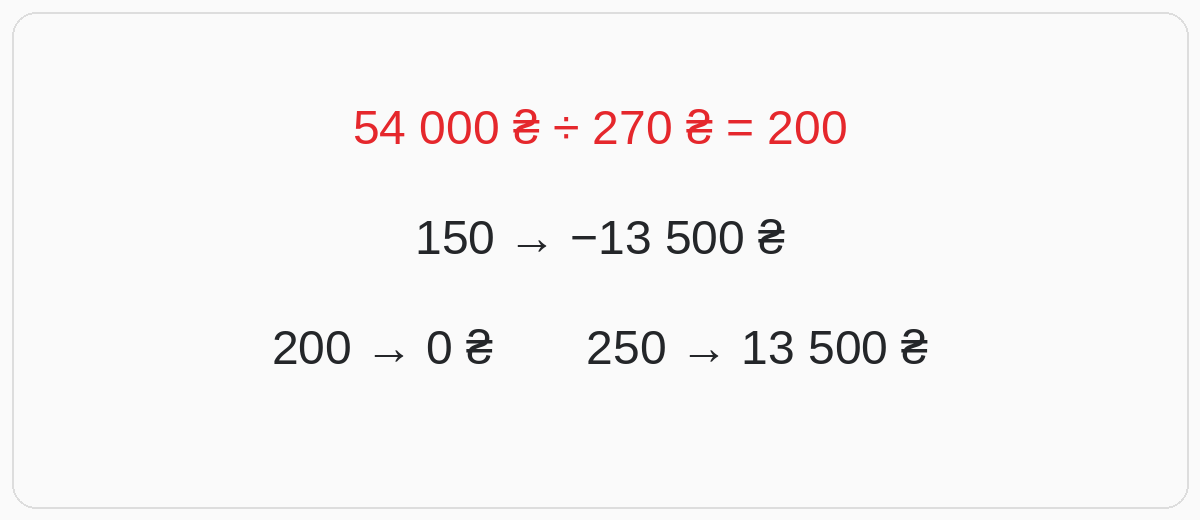
Illustrative example. The average order value is UAH 800, the purchase cost of goods sold is UAH 500, and packaging, payment fees, and expected returns-processing costs are UAH 30. The contribution from one completed order is: 800 − 500 − 30 = UAH 270. With fixed costs of UAH 54,000, the break-even point is: 54,000 ÷ 270 = 200 completed orders per month.
For a varied product range, calculate the weighted average contribution across order types with a defined basket composition: multiply each type’s contribution by its share of total orders, then add the results. Order types must be mutually exclusive, and their shares must total 100%. A calculation based on average order value works when the purchase mix is stable. Changes in product mix, discounts, or returns require recalculation. Round fractional orders up.
Illustrative example: three scenarios at a contribution of UAH 270 and fixed costs of UAH 54,000:
- 150 orders: revenue UAH 120,000, contribution UAH 40,500, result −UAH 13,500.
- 200 orders: revenue UAH 160,000, contribution UAH 54,000, result UAH 0.
- 250 orders: revenue UAH 200,000, contribution UAH 67,500, result +UAH 13,500.
For this example, assume that revenue of UAH 800 and cost of goods sold of UAH 500 per completed order already account for the effect of product returns. The UAH 30 covers packaging, payment fees, and returns processing. Other variable costs, including delivery paid by the store and fees per acquired order, are not included in the example; if they apply, add them to variable costs and recalculate the contribution, break-even point, and scenarios. The results shown are also before taxes, financing costs, depreciation, and owner compensation if it is not included in the budget. To determine net profit, include all relevant costs and taxes. Agree on their scope and payment dates with an accountant.
Prepare a weekly cash flow plan
For each week, record the opening cash balance, expected receipts, payments, and closing balance. Include payment dates for suppliers, rent, wages, taxes, customer refunds, and loan repayments. Include sales with deferred payment as receipts in the week when you expect to receive the money.
A cash shortfall occurs when available funds are insufficient to make payments when due. For that week, identify a funding source or agree to reschedule a payment. Check a scenario with slower sales and delayed receipts. Record inventory purchases as payments in the cash plan, and cost of goods sold in the result calculation; do not deduct the entire purchase again.
Track store cash flow in Torgsoft
In Torgsoft, financial transactions are assigned to financial analysis categories. You can view receipts, expenses, and balances by category for a selected period and store, as well as transaction details. The features are described in the financial analysis guide.
To check your plan, compare actual cash flow for the relevant categories with the budget. Transaction details can help identify the reason for a variance. This analysis shows cash flow; calculating net profit, forecasting sales, and preparing a future payment calendar require separate work.
Assign owners and review the plan monthly
For each action, set an owner, deadline, budget, and acceptance criterion: a supplier offer received, a demand test completed, or equipment ready. Each month, compare plan and actual figures for orders, average order value, contribution, fixed costs, inventory, and cash balance. Adjust the product range, purchasing, prices, and costs in response to variances, and recalculate funding needs.


 Go back to the previous step
Получил для себя, полезную информацию. Спасибо!
дуже цікаво