



Start TikTok influencer advertising with one test placement: check audience fit, agree on the terms, and calculate the sales needed. Base the decision on potential buyers’ location, results from comparable videos, and how much orders contribute toward covering costs.
Before paying, set a budget, a way to track purchases, and a criterion for working together again. This will help you assess the result after returns and decide whether to commission another video.
1. How to check a creator and their audience
First, describe the buyer: what they are looking for, where they live, how much they are willing to spend, and how they can receive the product. A shop offering in-store pickup needs an audience in the relevant city. For a store that delivers across Ukraine, check the share of Ukrainian viewers and whether you can fulfill their orders.
Find a creator by searching TikTok for your product category, reviews, and local topics, then contact them through the details they provide. If you have access to TikTok One, it includes checks for audience location and median views. Check separately whether the service is available for your account; you can arrange a direct collaboration through the creator’s contact details. These metrics are described in TikTok’s help center.
Review the creator’s ten most recent posts that are relevant to your product and planned format. Record the date, topic, views, whether the post contains advertising, and the substance of the comments. If there are few such posts, ask for more examples. Compare videos that are roughly the same age: a newly published video is still accumulating views.
Median views is the middle value in a sorted list. For ten videos, add the fifth and sixth values and divide by two. This helps estimate a typical result for the sample. Use follower count as an additional indicator.
- Ask for screenshots of analytics that show the date range and profile name: audience location, age, and views.
- Ask about completed ad collaborations: product, format, views, clicks, and confirmed orders, if they were tracked.
- Check the comments: do people ask about price, sizes, delivery, or product availability?
- Clarify who verified the sales results and how cancellations and returns were counted.
2. How many orders it takes to cover the cost
Revenue is the sales amount after discounts and returns. An order contribution is revenue minus the cost of goods and variable expenses: packaging, payment fees, delivery paid by the store, and return costs. This contribution covers advertising, fixed costs, and taxes.
Illustrative example. The creator’s fee is UAH 3,000, shipping the product costs UAH 200, and the cost of the gifted product is UAH 800. The collaboration budget is 3,000 + 200 + 800 = UAH 4,000. Count the gift at its cost. If it is already included in another budget item, do not add it again.
In this illustrative example, average revenue per completed order after returns is UAH 1,000, and the cost of goods and variable expenses are UAH 750. Contribution: 1,000 − 750 = UAH 250. Return costs are already included in this figure.
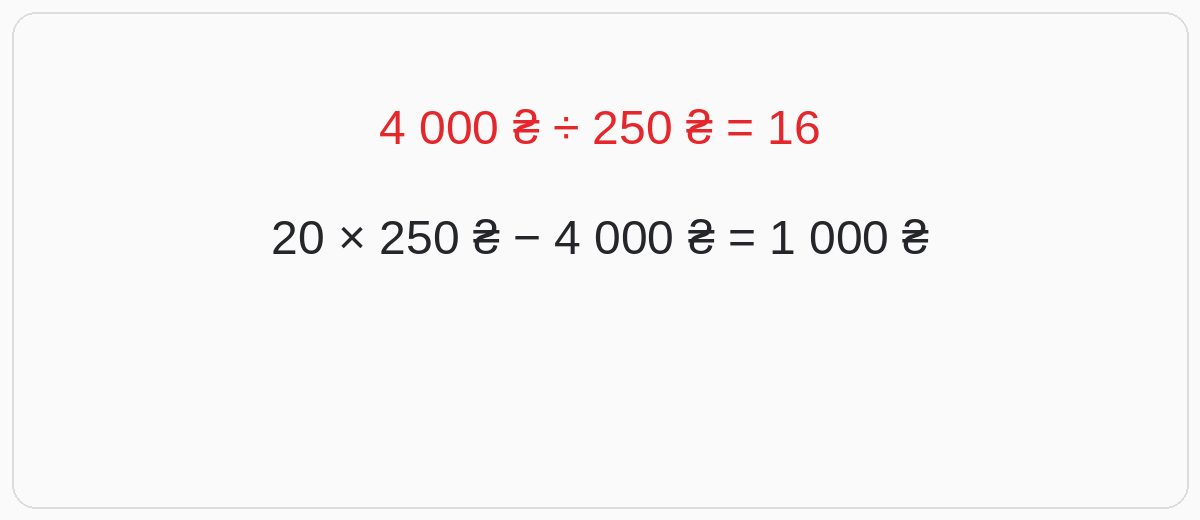
- To cover the budget: 4,000 ÷ 250 = 16 completed orders.
- With 20 orders, revenue is: 20 × 1,000 = UAH 20,000.
- Total contribution: 20 × 250 = UAH 5,000.
- After collaboration costs, the amount left is: 5,000 − 4,000 = UAH 1,000 before fixed costs and taxes.
Net profit is determined after accounting for all applicable expenses and taxes. If the calculation gives a fraction of an order, round up. Before launching, recalculate the contribution with the advertising discount included.
3. What to agree on with the creator in writing
Prepare a short brief: the product, the customer need, verified features, price, offer terms, and how to order. Suggest that the creator show the product in use and answer a typical customer question. Agree on the presentation format together.
- Number of videos, length, profile where they will be posted, and how long the video will stay up.
- Dates for receiving the product, submitting a draft, approval, publication, and reporting.
- Number of revisions, who approves the video, and what happens if there is a delay.
- Fee, shipping, status of the transferred product, and payment terms.
- Rights to reuse the video: channels, duration, territory, editing, and paid promotion; the separate cost of those rights.
Check the music before approving the video. TikTok provides a Commercial Music Library; other sounds require an appropriate license. Permission to use music on TikTok should not be treated as permission to use it on every other channel.
For a paid integration or a product provided in exchange for a post, agree on a visible “Реклама” (Advertising) label. The creator must also enable commercial content disclosure under TikTok’s rules. The requirement to label as advertising informational, author-created, or editorial material that draws attention to a specific person or product, creates or maintains audience awareness and interest in them, and is distributed for monetary or other compensation is established by Part 3 of Article 9 of Ukraine’s Law “On Advertising”.
4. How to track purchases after the ad
Give the creator a unique promo code or a tagged link. Agree on the measurement period in advance. Track inquiries, paid and completed orders, cancellations, returns, and contribution in hryvnias.
Attributed orders are purchases you link to the ad by code, link, or a customer’s response. Additional orders are purchases generated by the collaboration. A promo code may be shared with others or used by regular customers who already planned to buy.
To estimate the increase, compare sales with a similar period: the same weekdays, prices, assortment, and product availability. Account for other promotions and seasonality. This comparison provides a guide for your decision; its accuracy depends on how comparable the conditions are.
5. Surveying customers in Torgsoft to assess advertising
In Torgsoft, you can create a question with answer options, collect responses during a sale or a follow-up call, and analyze them by period and store location. The features are described in the customer survey guide.
For a test placement, ask, “Звідки ви дізналися про цю пропозицію?” (Where did you hear about this offer?) and include a separate option for the creator, along with “Інше” (Other) and “Не пам’ятаю” (I don’t remember). A customer may forget the source or have seen several advertising messages. Compare responses with completed orders and promo codes, avoiding double counting.
6. Checks before launch and another collaboration
- Confirm the audience location, median views, and the creator’s experience.
- Check stock, price, delivery, and the order process on a phone.
- Agree on the draft, labeling, rights, budget, and reporting deadlines.
- After publication, get the link and analytics screenshots for the agreed period.
- After accounting for returns, compare order contribution with the budget and estimate the possible increase in sales.
Official source
Ukraine’s Law “On Advertising” No. 270/96-VR, Article 9 — identification of advertising


 Go back to the previous step