


A buyer persona is a practical description of a group of customers with a similar need, buying situation, selection criteria, and barriers. To use one to improve your store, gather evidence about recent purchases and abandoned purchases, then compare it with sales, returns, and customer questions. Next, identify what information people are missing and what needs to change on your website or in your service.
Start with a specific task: help shoppers choose a size, compare models, or understand delivery terms before paying. For each finding, note its source and your confidence in it. After making changes, track the agreed metric and keep talking to customers: simply having a persona does not guarantee increased sales.

Illustrative portraits. Shoppers’ needs are determined by researching their experiences.
- What to include in a buyer persona
- Start with a question the store needs to answer
- Who to invite for a conversation
- How to interview without leading questions
- How to distinguish evidence from a hypothesis
- Buyer persona template for a store
- Hypothetical example: a shoe buyer who needs to check the size
- How to turn a persona into changes in your online store
- How to measure the result and review the persona
- How to collect customer data in compliance with Ukrainian law
- How to use surveys and customer analysis in Torgsoft
What to include in a buyer persona
A useful persona explains what a person wants to do, the circumstances in which they choose a product, and what influences their decision. For example, you might describe a group as “people buying shoes online for the first time who need help choosing a size.” That description immediately suggests a task for the product page: show how to measure a foot, provide the measurements for the specific model, and explain the exchange terms clearly.
A person may belong to different groups depending on the purchase. They may compare specifications carefully when buying for themselves, but choose a gift mainly based on when it will arrive. So group customers by the context of their decision. Add age, occupation, or location only when evidence shows how those factors relate to their choices.
- Need: the outcome the buyer wants from the product.
- Situation: what prompted the search, and what deadlines or constraints affect the purchase.
- Alternatives: which products, stores, or other ways to solve the problem the person considered.
- Criteria: the features the buyer used to compare offers.
- Barriers: what made them hesitate, delay their decision, or abandon the purchase.
- Information needed: what the store should explain before checkout.
Do not assign a group a personality, income level, or digital skills based on age or appearance. Do not infer health, beliefs, or family circumstances from a product someone bought. To decide whether you need a size chart, it is usually enough to know how the buyer chose a size and what information they were missing.
Start with a question the store needs to answer
Before collecting information, write down a decision you will be able to make as a result. Instead of a general goal such as “understand customers better,” be specific: “find out what to show on shoe product pages so buyers can choose a size on their own.” This keeps your interviews and analysis focused on information that can inform a concrete change.
Choose one category or one stage of the buying process. Assign one employee to collect responses and another person who can change the page or process. Agree in advance on how you will assess the result—for example, by the number of size-related enquiries per 100 orders and the share of returns due to size not fitting.
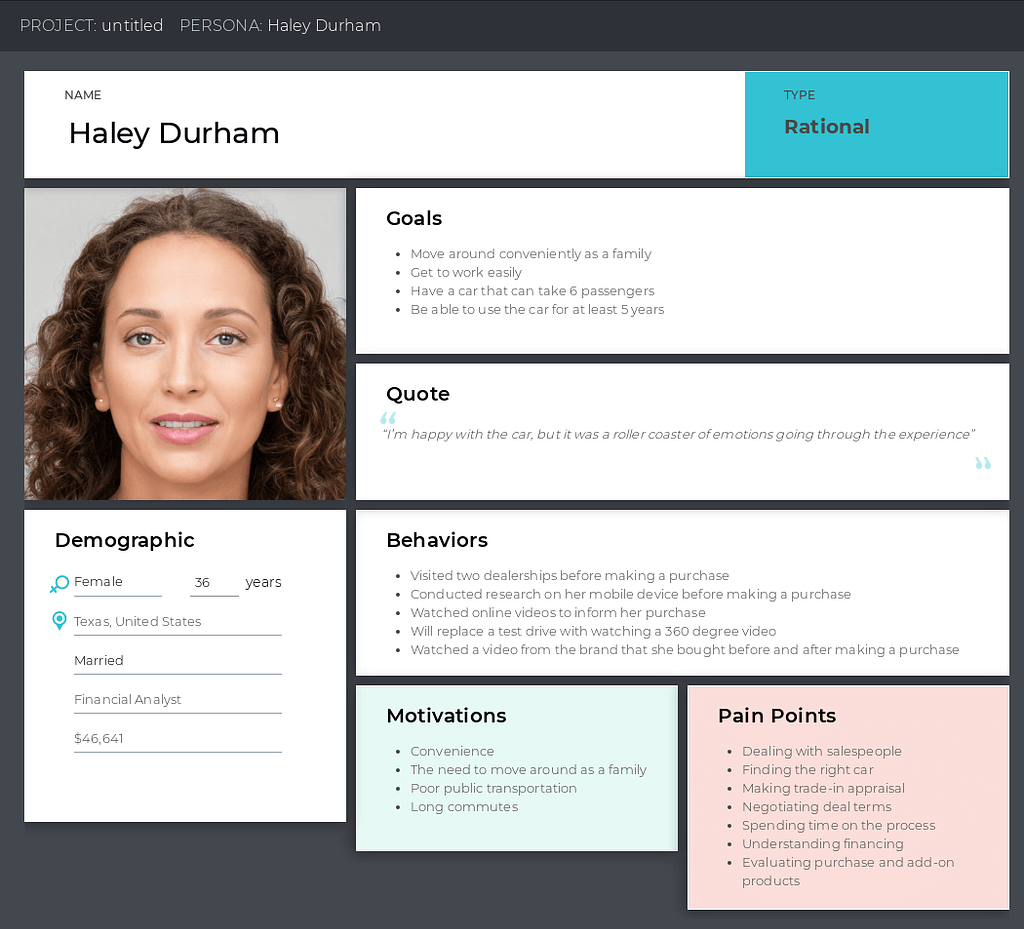
Example of a persona profile showing goals, behavior, and challenges. The information in the example is not based on research into your store’s customers.
Compare three sources of information
- Conversations with customers. These can help you reconstruct the decision process and hear the person’s own explanation. Record their specific experience separately from your interpretation.
- Aggregated sales and returns. Choose a period, category, and sales locations. Check the number of orders, repeat purchases, and returns, along with any recorded reasons for returns. If no reason was recorded, that does not mean there was no problem.
- Customer enquiries. Collect recurring questions from chat, phone calls, and in-store conversations. Group them by topic: compatibility, size, what is included, payment, or delivery. Do not copy unnecessary contact details into your working spreadsheet.
Each source has limitations. Sales show that a product was bought, but not why. An interview captures one participant’s explanation, but cannot show how common that experience is among all customers. Questions to sales staff reveal the difficulties faced by people who asked for help, while people who left without asking are missing from those records.
Who to invite for a conversation
Invite people who recently bought a product, considered it but did not buy it, or directly said they decided against it. Include customers who returned a product if their experience is relevant to your task. To start, you could plan a few conversations with people from each available group, then recruit more participants to fill gaps in your answers. This initial number is a practical choice for the store; it does not make the sample statistically representative.
Do not limit your interviews to loyal, satisfied customers: their experience will not explain every reason for abandoning a purchase. At the same time, do not assume that someone who left a cart is a confirmed “price-related drop-off.” Unless they told you the reason, you do not yet know it.
For invitations, use only contact details that you have an appropriate legal basis to process and use for this purpose. People who have not bought anything can be invited to voluntarily sign up for a conversation on the website. Accept a refusal to participate without pressing again.
How to interview without leading questions
At the start, name the store, explain the purpose and expected length of the conversation, and say how you will use the answers. Tell participants that they can skip a question or end the conversation. If you plan to record audio, get separate agreement to the recording; without it, stick to necessary notes.
Ask the person to recall a specific recent situation. The question “How did you choose this product?” gives them room to describe their own experience. The wording “You found it hard to find your size, didn’t you?” already suggests an answer and makes it harder to test the store’s assumptions.
- How the search began. “Think about the last time you looked for this product. What happened, and what did you need it for?”
- Circumstances. “By when did you need it? What conditions did you need to take into account?”
- Finding options. “Where did you start looking? Which offers did you consider next?”
- Comparing options. “How did you compare those options? What did you check first?”
- Looking for information. “What did you want to find out on the product page? How did you look for the answer?”
- Hesitation. “At what point did you stop or ask for help? What exactly was still unclear?”
- Decision. “What did you end up doing? What had the biggest influence on your choice?”
- After the purchase. “How well did the product work for what you needed? What did you find out after receiving it?”
Ask follow-up questions about the sequence: “What happened next?”, “What exact information did you see?”, “How did you know the model was right for you?” If someone says “it was expensive,” ask which offer they compared the price with and what was included in the price. Do not explain the store’s advantages while you are trying to find out why they abandoned the purchase, as that will change the nature of the conversation.
Do not treat “I would use a comparison tool” as evidence that the person actually used one. After the interview, you can give them a separate practical task: find a product for their situation on the current page or a new version of it. Observe what information they find on their own and where they need a prompt.
How to distinguish evidence from a hypothesis
Create a record for each conversation with a participant code, date, product category, and purchase outcome. Label a verbatim quotation as a quote and a summary as a summary. Record your own explanation of the reason in a separate field so the team does not mistake it for the buyer’s words during discussion.
Evidence might be a participant saying they could not find the shoe’s internal length, or your observation that they looked for it in the description. A hypothesis would be the store’s assumption that adding this measurement will reduce size selection mistakes. Even a plausible explanation needs to be tested.
Group records by recurring needs and ways of choosing. If several people were looking for a gift to arrive by a certain day, check whether the delivery date drove their decision. People who first checked whether they could exchange a gift may need different information on the page.
For internal work, you can use three confidence levels. “Low” means a single comment or untested assumption; “medium” means a finding has recurred in several independent conversations; “higher” means consistent evidence from interviews, enquiries, and record data over a defined period. This is a suggested working scale, not a statistical measure of reliability.
Buyer persona template for a store
Fill in one table like this for each group that requires a separate decision. The name should describe the buying situation. If you do not have evidence for a field, write “needs verification” and add a next step.
| Field | What to record |
|---|---|
| Group name and boundaries | The shared situation, category, and sales channel; cases the description does not cover. |
| Sources and dates | Interview codes, conversation dates, the sales and returns period, and the list of aggregated enquiries. |
| Confidence | Your confidence level, the reasons for it, and any conflicting evidence. |
| Need and situation | The desired outcome, what prompted the search, deadlines, and constraints. |
| Alternatives | The products, stores, or other ways of solving the problem that people actually considered. |
| Selection criteria | What people checked and what influenced the final decision. |
| Concerns and barriers | What information was missing, what caused hesitation, and what led to an enquiry or abandonment. |
| Useful information on the page | A product feature, instruction, comparison, or service term that needs explaining. |
| Store decision | The specific change, the employee responsible, and the deadline. |
| Evaluation | The hypothesis, outcome metric, comparison method, and review date. |
Keep conflicting responses. If some buyers are willing to wait for a particular colour while others need the product immediately, check whether those are two different buying situations. Do not average them into a statement such as “customers care about both colour and speed” if it does not help you decide what to prioritize on the product page.
Hypothetical example: a shoe buyer who needs to check the size
All circumstances and numbers in this example are fictional and are provided to explain the method. They do not describe research by a specific store or real customers. Imagine a shoe store that conducted eight conversations with customers and people who did not complete a purchase. Five said they had looked for measurements for a specific model; two of them abandoned the order because they could not determine their size. This is a reason to investigate the problem, but this sample cannot tell you what share of all visitors it affects.
The store creates a working description: “Ordering an unfamiliar model and checking the fit.” The group’s need is to receive shoes in the right size. The situation is an online purchase without trying them on; alternatives include another model, advice from a sales assistant, or visiting a store. The criteria are the model’s measurements, how they compare with the buyer’s own measurements, and clear exchange instructions. The assumption “all these buyers are looking for the cheapest product” is left out because there is no evidence for it in this example.
The store’s decision is to verify the measurements, add them to product pages in the selected category, and explain how to use them. The team then checks whether buyers can find the information and choose a size without help. It also tracks returns separately, since fewer questions do not prove that buyers are choosing correctly.
How to turn a persona into changes in your online store
For each change, record the evidence behind it and the action you expect buyers to take after the update. Before publishing, the employee responsible for the product or delivery must verify the actual specifications and terms: research into customer needs does not confirm product specifications or a carrier’s delivery times.
| What you found | What to change | How to evaluate the benefit |
|---|---|---|
| Buyers do not know whether a product will work with their device. | State the verified compatibility, limitations, and how to check the device model on the product page. | Ask a participant to determine compatibility; track enquiries and returns for this reason separately. |
| People can see the specifications for two models but do not understand the practical difference. | Add a comparison based on the criteria from the interviews and explain what the differences mean in use. | Check whether a person can choose a model for their task and explain their choice. |
| The decision depends on receiving the product by a certain day. | In the delivery section, separate preparation time from transit time, show available delivery methods, and state known limitations. | Find out whether buyers understand the delivery times before paying; track cancellations due to delivery. |
| The buyer learns about extra charges only at the end. | Show the known components of the total earlier in checkout and explain what any uncertain costs depend on. | Check whether buyers understand the total, and measure the share of completed orders using the agreed method. |
If the change is for a physical store, use the same evidence to update a price tag, a short guide, or sales staff’s questions. For example, before selling an accessory, a sales assistant could ask which device model the customer has. This lets the team check the relevant specification before the purchase.
How to measure the result and review the persona
Before making an update, define the primary metric, data source, and calculation method. For a size issue, one option is the number of size-related enquiries per 100 orders in the category. Also check returns and cancellations so a decline in enquiries does not hide new problems.
Hypothetical numerical example: before the change, the store received 40 enquiries for 200 orders, or 20 enquiries per 100 orders. After the change, it received 24 enquiries for 200 orders, or 12 per 100. That is a difference of 8 enquiries per 100 orders, or a 40% reduction from the original level: (40 − 24) ÷ 40 × 100%. These figures illustrate the calculation; on their own, they do not prove that the new size chart caused the change.
Compare the same categories under conditions that are as similar as possible. Record changes in prices, advertising, product range, stock availability, and delivery, as these can also affect the result. Allow for the time it takes for returns to appear. If you change several elements at once, it will be harder to determine the contribution of each one.
Set a review date for the persona and revisit it sooner if conflicting answers emerge, a new category appears, or service conditions change. Keep the observations that are supported, refine the group’s boundaries, and update your hypotheses. If you do not get the expected result, check whether you understood the cause of the difficulty correctly and whether buyers noticed the change.
How to collect customer data in compliance with Ukrainian law
The Law of Ukraine “On Personal Data Protection” applies to the work described here for a Ukrainian store. Article 6 requires a defined lawful purpose, transparent processing, and an appropriate, non-excessive set of data. Data in a form that allows a person to be identified must not be stored longer than necessary for the lawful purposes of processing.
Before sending invitations and conducting interviews, determine the legal basis for each specific form of processing. Article 11 of this Law provides, among other things, for consent, entering into and performing a transaction, fulfilling a legal obligation, and protecting legitimate interests. The last basis has a limitation: the need to protect a person’s fundamental rights and freedoms may outweigh those interests. Having someone’s phone number for delivery does not in itself justify every later use of that contact.
Consent does not remove the requirements concerning purpose, scope, and data protection. If the new purpose is incompatible with the previous one, Article 6 requires consent to processing for the changed purpose, unless otherwise provided by law. So assess interviews, recordings, and subsequent marketing messages separately.
- Collect only what is necessary. To analyse choices, the buying situation, answers, and a participant code are usually enough. Store contact details needed to arrange a conversation separately from the analytical record.
- Explain how the data will be used. Tell people who is collecting the data, why, who will have access to it, and where they can contact you about it. Article 8 of the Law provides the right to know the purpose and terms of access, obtain one’s own data, and withdraw consent.
- Limit access. Share summaries with the team without names or phone numbers. A participant code does not remove the need to protect the data if you can identify someone using a separate list or the content of their answers.
- Set a retention period. Record when you will delete the contact list, recordings, and other materials that allow identification, taking the purpose and legal obligations into account.
Under Article 24 of the Law, personal data owners and processors must protect data against unlawful access or processing, accidental loss, or destruction; an individual entrepreneur is personally responsible for protecting the data they own. If you work with an external researcher or designer, share summaries first. Assess any transfer of personal data separately in light of Article 14, which sets rules for disclosure and the limited cases in which data may be transferred without consent under the law.
How to use surveys and customer analysis in Torgsoft
In Torgsoft, you can organise response collection through “Маркетинг → Система опитування клієнтів” (Marketing → Customer Survey System). According to the official instructions, you need to create active questions and answer options, set dates and accounting centres, choose where the survey will appear, and activate the system on the “Налаштування” (Settings) tab. The survey you create will not work unless it is activated. The available display modes are “Реалізація” (Sale), “Торгівля з випискою рахунка” (Trade with invoice issuance), or both.
In the first mode, the employee sees the question before payment; in the second, before creating an outgoing goods note. The employee asks the buyer the question and selects their answer in the program. For this format, prepare a short, neutral question on topics already identified in conversations. Buyers can decline to answer.
On the “Аналіз опитування” (Survey Analysis) tab, you can select the response period and response accounting centre, then view a count and chart. To compare responses with purchases, use “Аналіз → Аналіз активності покупців” (Analysis → Buyer Activity Analysis): set the activity period and accounting centre, then review the number of purchases and other available metrics. If these fields are blank, the analysis will cover the entire record-keeping period and the whole retail network. The revenue from sales metric in this report does not account for returns, so conclusions about returns require a separate comparison.
In practice, these modes can be used to compare responses and form customer groups for follow-up conversations. The instructions also describe post-sale calls; filtering by interests requires the additional “Профіль клієнта та дзвінки Binotel” (Customer Profile and Binotel Calls) option to be activated. Before setting this up, check that the required modes are available in your configuration and review the licence terms. The program counts responses and displays activity; the owner or researcher interprets the evidence, develops the persona, and evaluates the store’s decisions.


 Go back to the previous step