


To sell through social networks using the dropshipping model, first check demand and choose one channel. Before each product post, confirm the stock, price, and dispatch time with the supplier. Set up your work so buyers receive an accurate offer, clear ordering terms, and a seller contact who can handle any issues after the sale.
Social media marketing, or SMM, should be evaluated by completed orders and the money left after related costs. Below is a recommended workflow for a Ukrainian seller offering products to consumers in Ukraine for personal use. Planning and testing advice is practical guidance; legal requirements are accompanied by links to official sources.

How to choose one social network after checking demand
Start with a specific question: who buys your product, what do they need it for, and what might stop them from placing an order? Review your own inquiries, ask potential buyers where they look for similar products, and invite them to discuss a real offer with a price and delivery terms. Do not collect participants’ phone numbers during this discussion if they are not yet ordering a product.
For an initial test, we recommend this sequence:
- Identify one buyer need: for example, finding an organizer that fits the exact dimensions of a drawer.
- Prepare a short product offer with confirmed specifications, price, and dispatch terms.
- Find out which social network potential buyers prefer for viewing the offer and asking questions. This could be Instagram, Facebook, or TikTok. Base your choice on the inquiries you receive and your capacity to serve customers.
- Choose one channel where you can regularly create the required format and respond to buyers. State your business hours and realistic response time.
- Record questions, refusals, and orders. If inquiries do not turn into purchases, check the reasons: unsuitable dimensions, unconfirmed stock, price, delivery, or unclear terms.
One possible test is two weeks, with three main posts each week and a daily check of messages during set hours. This is a suggested working rhythm that you can adjust to your workload. Consider adding a second channel after you can explain the results from the first and handle new inquiries without delays.
What to check with the supplier before posting
Keep an offer verification table. For each stock keeping unit (SKU), record the product variant, quantity the supplier can ship, purchase price, your selling price, dispatch time, the date and time of the check, and the person responsible. Save the supplier’s confirmation. If you work alone, carry out all these checks yourself.
- Availability. Confirm the specific color, size, and configuration, as well as whether the item can be reserved. A general “in stock” notice may not apply to the variant you need.
- Price. Check the purchase cost, packaging fees, and any other agreed charges. Work out whether the selling price covers the costs of handling the order and promotion.
- Dispatch. Get a confirmed time for handing the parcel to the carrier, and account for the supplier’s order intake hours and business days. Explain the transit time to the buyer separately.
- Specifications. Compare the description, labeling, instructions, and photos against the exact SKU. Do not carry over specifications from another model.
- After-sales service. Agree where returns must physically be sent, who inspects the product, and how the supplier will report the result to you. Give buyers your own process for contacting the seller.
Repeat the check just before a scheduled post goes live and before confirming an order. If the supplier has not confirmed the product, pause its promotion until you have clarified availability. If an ordered product is no longer available, inform the buyer immediately and agree on the next steps. Do not send a different model without proper agreement. Under Part 6 of Article 13 of the Law of Ukraine “On Consumer Rights Protection,” unless the contract provides otherwise, the seller must deliver the product within a reasonable time, but no later than 30 days after receiving the buyer’s consent to conclude the contract.
The seller must notify the buyer immediately, and no later than within those 30 days, if the contract cannot be fulfilled because the product is unavailable.
The legal basis for these checks is the obligation to provide accurate information before purchase and ensure that the product matches the agreed specifications. Failure to obtain information from the manufacturer does not release the seller from liability: Article 15 of the Law of Ukraine “On Consumer Rights Protection” and Article 7 of the Law of Ukraine “On Electronic Commerce”.

How to prepare an accurate description and use photos lawfully
For each offer, prepare a short description with the product name and SKU, purpose, verified specifications, what is included, usage limitations, price, delivery, and ordering method. The price must include mandatory charges payable by the buyer. State prices in advertisements for goods sold in Ukraine in Ukrainian hryvnias (UAH), as required by Part 8 of Article 8 of the Law of Ukraine “On Advertising”.
If special requirements for information, warnings, or documents apply to the product category, check them before promoting the product. A general description in a post does not replace mandatory labeling or accompanying documentation. For goods whose advertising or sale requires a relevant certificate, permit, or license, take into account the restrictions in Article 8 of the Law “On Advertising”.
We recommend keeping written confirmation with the photos showing that the rights holder permits you to use them in your posts and advertising. Clarify which channels are permitted, whether cropping or adding text is allowed, and how long you can use the images. Simply receiving a file from a supplier does not establish the scope of the rights granted. If you photograph a sample yourself, show its actual appearance, dimensions, and details that affect the buying decision.
For user-generated content, including customers’ photos, videos, and reviews, obtain separate permission to use the material and publish the person’s name or image. Article 8 of the Law “On Advertising” requires written consent, including electronic consent, to use an individual’s image or name. If a person posed or performed a role to create an advertisement in exchange for payment, Article 8 permits the use of their image without separate consent, provided the advertiser has sufficient intellectual property rights in the advertisement for the chosen method of distribution.
This exception does not automatically apply to use of the person’s name. For an ordinary customer review, obtaining separate consent is a sensible practice. Remove phone numbers, addresses, shipment numbers, and other unnecessary personal data from screenshots.

Weekly content plan: from a buyer’s question to a verified post
Plan posts around questions buyers ask before paying. The table below is a recommended example for an organizer seller. Before using it, adapt the topics to your own products and assign responsibility to specific people.
| Day and buyer question | Fact to confirm | Format | Call to action | Who checks it |
|---|---|---|---|---|
| Monday: “Will it fit in my drawer?” | External dimensions of the specific model and installation requirements | Photo with dimensions and an explanation of how to measure | “Send us the inside dimensions of your drawer privately” | Content manager checks the information against documentation or a measured sample |
| Tuesday: “What is included?” | Quantity and list of components for the required SKU | Short video or a sequence of photos | “Send us the SKU to confirm what is included” | Order manager obtains supplier confirmation |
| Wednesday: “When can you dispatch it?” | Variant availability, dispatch time, and delivery terms | Short message with the time of the check | “Send the model and delivery location to confirm delivery” | Order manager rechecks the information before posting |
| Friday: “What does the product look like in use?” | Whether the product shown matches the SKU, rights to the material, and the person’s consent | Your own demonstration or a customer video used with permission | “Ask us about a detail not shown in the video” | Owner checks permissions; content manager checks that the description is accurate |
| Sunday: “How do I contact you if the product doesn’t suit me?” | Seller’s contact details, contact process, and applicable return terms | Post with answers and a link to the full terms | “Save the terms; message us privately about your order” | Owner checks the process and contact details are accessible |
Before posting, the person responsible must confirm the facts, rights to the materials, and that the terms are current. If the price or availability has changed, update active offers and stop advertising with inaccurate information. Discuss changes to an order that has already been agreed with the buyer separately.
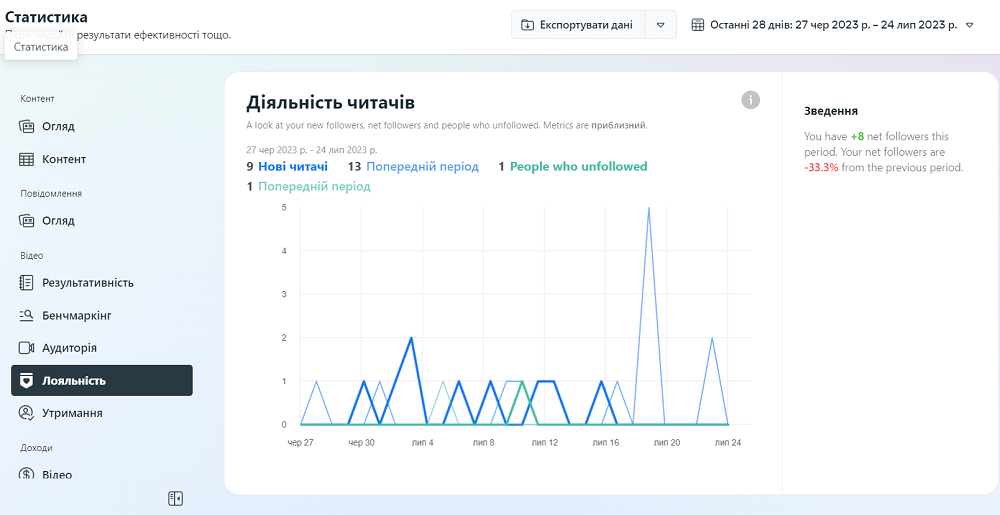
The screenshot shows an example analytics dashboard. The dates and metrics shown are not current results for the store.
Three post templates to adapt
The following texts are templates. Fill in every field in square brackets with verified information and add the required advertising label if the post is an advertisement.
1. Post about fit for the buyer’s needs. “To check whether the organizer [name, SKU] will fit, measure the inside width, depth, and height of your drawer. This model measures [confirmed dimensions]. It includes [list]. Please note [confirmed limitation]. Price: UAH [amount] [information about included taxes]; delivery payment terms: [terms]. Message us your measurements privately and we’ll compare them with the model’s specifications. Order and return terms: [link].”
2. Post about availability and dispatch. “The supplier confirmed availability of [name, SKU, variant]; checked on [date, time]. Price: UAH [amount] [information about included taxes]. After order confirmation, dispatch is planned for [timeframe and terms]. We’ll confirm transit time separately; delivery costs [amount or how it is calculated] and is paid by [party]. Seller: [name]; our supplier dispatches the product. To order, message us the SKU and quantity privately so we can recheck availability. Full terms: [link].”
3. Promotional post about a discount. “Реклама. The discount on [name, SKU] runs from [start date] through [end date] at [store name, page address, or website]. Previous selling price: UAH [amount]; discounted price: UAH [amount]; discount: [percentage or amount]. The offer applies to [exact list of variants]; limitations: [actual limitations or none]. Delivery: [cost and terms]. Message us the SKU privately so we can check availability before confirming your order. Full terms: [link].”
How to label advertising and announce promotions
Check whether a message is advertising and whether the discount terms are accurate as separate issues. Under Articles 9 and 14-2 of the Law “On Advertising”, advertising must be identifiable, and users must label advertising content when creating or uploading it to the relevant platform. Material that draws attention to a product in return for monetary or other compensation must be identified as advertising using the Ukrainian word “реклама” (“advertising”). This also applies to an agreed promotional review in exchange for a free product, service, or discount.
When arranging a review with a creator, agree in writing on the product, verified claims, compensation, advertising label, rights to reuse the content, and how errors will be corrected. Ordinary information about a product is not considered advertising under Article 15 of the Law “On Consumer Rights Protection.” Part 7 of Article 8 of the Law “On Advertising” sets out a separate exception for information presented while placing an order on an online store website; do not automatically extend that exception to every social media post.
You may announce a discount on products that you sell directly for a defined, limited period, provided the price is genuinely lower than usual. Show the previous and new prices. The term “sale” applies to all goods at a particular location or to a clearly defined group, for a limited period and at prices lower than usual. These are the conditions in Parts 4–6 of Article 15 of the Law “On Consumer Rights Protection”.
An advertisement for a price reduction or sale must state the location, start and end dates, and how the new price compares with the previous price or the discount amount. Advertisements for contests and prize draws must state the timeframe, location, and source of the full terms. Announce changes in the same way as the original information. These requirements are set out in Article 8 of the Law “On Advertising”.
In practice, keep a price history and confirmations of stock levels. Do not claim “only two left” without checking, reset a made-up “today only” deadline every day, buy fake comments posted as customers, or cite research you cannot verify. Publish genuine reviews with agreed wording and the necessary permissions.
How to take orders in private messages
Make seller information directly and consistently accessible from your profile. Under Article 7 of the Law “On Electronic Commerce”, this includes the full legal name of a legal entity or the surname, first name, and patronymic of an individual entrepreneur; the legal entity’s location or the individual entrepreneur’s place of registration and actual residence; an email address and/or online store address; and an identification code or taxpayer registration card number. For an entrepreneur who has lawfully refused such a number for religious reasons, passport details are provided instead. Also publish license details if the activity is licensed, information about taxes included in the price, delivery information, and other required details.
If you are the one entering into a sales contract with the buyer, you remain the seller even when the supplier packs and dispatches the product. Coordinate the logistics with your partner yourself and handle inquiries about order fulfillment. The seller’s obligations are set out in Articles 7 and 11 of the Law “On Electronic Commerce” and Articles 8 and 13 of the Law “On Consumer Rights Protection.”
Below is a recommended short script. Provide the product, delivery, payment, warranty, and return terms before the buyer accepts the offer, and confirm them by electronic message.
- Clarify the product. “Hello! Which SKU, variant, and quantity are you interested in? I’ll check availability and dispatch with the supplier.”
- Make a confirmed offer. “Confirmed: [product, specifications, quantity]. Seller: [name, link to business details]; our supplier handles dispatch. Total product price: UAH [amount], taxes [information]. Payment: [method, deadline, recipient]. Dispatch: [agreed timeframe]. Please tell us the delivery location and preferred delivery method so we can determine the delivery cost and any payment fee.”
- Provide full terms before placing the order. “Delivery: [amount]; payment fee: [amount or none]; paid by [party]. Total: [amount]. Estimated transit time: [timeframe]. Warranty: [terms]. We accept inquiries and returns through [contact]; process, deadlines, address, and applicable exceptions: [accessible link]. We will provide a payment receipt by [method].”
- Request only the minimum data privately. “For delivery we need [recipient’s first and last name, phone number, branch or address, depending on the delivery method]. We use these details to fulfill the order. We pass the necessary information to [supplier name] and [carrier] for dispatch. Information about data processing: [link]. Please confirm your consent to this specified transfer.”
- Check and place the order. “Please check the product, total, terms, and address. If everything is correct, place the order using [agreed method and explanation of the action that means you accept the offer]. We’ll send confirmation once we receive the order.”
The process for accepting an electronic offer must comply with Article 11 of the Law “On Electronic Commerce”. Do not treat a message saying “I’m interested in the product” as confirmation that the buyer accepts all terms. Under Part 14 of Article 11 of this Law, prepare the offer, electronic contract, and electronic messages in Ukrainian. At the buyer’s request, the electronic contract may be concluded in another language by agreement between the parties. Keep a copy of the agreed offer and order confirmation. State in the offer or electronic contract how the buyer can obtain them in a form that prevents changes to their content. In practice, you can send the buyer a separate document setting out the agreed terms.
Do not ask buyers to post a phone number or address in comments. For an ordinary shipment, do not collect passport copies, date of birth, or other details unnecessary to fulfill the order. Article 7 of the Law “On Electronic Commerce” allows you to request only necessary data; Articles 6, 11, and 14 of the Law “On Personal Data Protection” set requirements for the purpose, scope, grounds for processing, and transfer. Contract fulfillment is a separate legal basis for processing, and information transfers to the supplier and carrier must be properly arranged. Give access only to employees who need it and do not retain the data longer than necessary for lawful purposes.
For marketing messages, obtain separate prior written consent, including electronic consent, and provide a simple, free way to opt out. Placing an order does not mean the buyer has agreed to receive future advertising. This approach reflects Article 14-3 of the Law “On Advertising”; keep messages about the order itself separate from promotional offers.
What to tell buyers about delivery and returns
Before concluding the contract, provide the seller’s name and location, how to submit complaints, product characteristics, full price including delivery, payment and delivery terms, warranty obligations, the period for accepting the offer, and how to terminate the contract. Confirm this information electronically: the seller may not unilaterally change information that has already been confirmed. These are the requirements in Parts 2–3 of Article 13 of the Law “On Consumer Rights Protection”.
Under Part 4 of Article 13, a consumer may notify the seller of termination of a distance contract within 14 days from confirmation of the information or receipt of the product or first delivery. Returning a physical product also indicates termination of the contract. If the confirmation does not meet legal requirements, the period for a physical product is 90 days from receipt of the product or first delivery. If the seller corrects the confirmation within those 90 days, the consumer has 14 days from receipt of the corrected confirmation. Do not replace these rules with a blanket “no returns” notice.
The right to terminate is subject to statutory exceptions. For retail sales, check in particular whether the product was made or modified to individual specifications and cannot be resold, or resale would cause significant financial losses; whether sealed computer software media have been opened; and whether the product is a periodical publication. Part 5 of Article 13 also lists other special cases, including electronic supply under specified conditions. Ordinary dispatch of a physical product by a carrier is not, by itself, electronic supply of that kind. Do not apply an exception to your entire range; more favorable terms may be provided in the contract.
Under Part 7 of Article 13, Parts 5–9 of Article 12 apply to distance contracts. In particular, the seller bears the costs of return in such a termination. The buyer must keep the product in an unchanged condition. However, destruction, damage, or deterioration not caused by the buyer does not deprive them of the right to terminate the contract. That right is also retained if the product’s value has decreased because its packaging was opened or it was inspected or tested. In your process, explain how the buyer gives notice of termination, where the seller can collect the product, how the return is arranged, and when and how the seller refunds the money. Under Part 5 of Article 12, the buyer’s duty to keep the product ends 60 days after receiving it. If the seller has not taken steps to recover the product within that time, ownership passes to the buyer without an obligation to pay for it. Part 9 of Article 12 provides for a penalty of 1% of the product’s value for each day a refund is late beyond the applicable deadline. Distance contract termination rules: Articles 12–13.
Handle complaints about defects separately. Under Article 8, during the applicable warranty period, the buyer may request a proportionate price reduction, free repair of defects, or reimbursement of repair costs. For significant defects caused by the manufacturer or seller, or for counterfeit products, the law provides for replacement or contract termination with a refund under specified conditions. Accept the complaint, record the remedy requested, and arrange an inspection. Do not refuse solely because the supplier dispatched the product. Article 8 of the Law “On Consumer Rights Protection”.
Decide in advance who prepares and provides the payment receipt to the buyer. Part 11 of Article 8 requires it to be issued or created electronically no later than when the product is transferred. Articles 11 and 13 of the Law “On Electronic Commerce” separately regulate confirmation of the transaction and receipt of funds. A dispatch notification does not replace these documents.
The consumer protection rules above are based on Law No. 1023-XII. When applying Law No. 3153-IX, take into account its deferred entry into force, which is linked to the termination or cancellation of martial law. Do not apply its future rules to your terms prematurely. Official status of Law No. 3153-IX.
How to evaluate the test: completed orders, returns, and costs
For each inquiry, we recommend recording its source, post, SKU, and reason for refusal. For each order, record its number and successive statuses: confirmed, paid, dispatched, received, and returned. Use the order number in your results table without duplicating addresses and phone numbers. Track refusals to accept delivery separately from returns after receipt because their causes and costs may differ.
For each test, compare:
- the number of orders received by buyers and the number they kept after returns;
- cancellations due to product unavailability, refusals to accept delivery, and returns, with reasons;
- revenue after refunds to buyers;
- costs for the supplier, payment processing, packaging, delivery, returns, content, and advertising;
- the sales contribution toward fixed costs: revenue minus variable costs related to those sales and the cost of the test.
Illustrative calculation. The test generated 20 paid orders at UAH 1,000 each. Two were fully returned, the buyers received refunds, and the supplier fully refunded the cost of those two products. The remaining 18 orders generated revenue of UAH 18,000. The cost of their products from the supplier was 18 × 650 = UAH 11,700. Fees were UAH 540, delivery paid by the seller was UAH 360, additional return costs were UAH 300, and advertising cost UAH 1,800. There are no other variable costs in this example.
The contribution is 18,000 − 11,700 − 540 − 360 − 300 − 1,800 = UAH 3,300. Advertising cost per order kept by the buyer is 1,800 ÷ 18 = UAH 100. This is not net profit: fixed costs and taxes not included in the example still need to be covered by the contribution. If the supplier charges a return fee or does not refund the cost of the product, add those amounts to costs.
For the next illustrative test, you could set a total advertising limit of UAH 1,800 over six days and compare two message variants sequentially for three days each, with a limit of UAH 300 per day. Keep the product, price, and terms the same to make the difference easier to explain. This small test provides information for a future decision, but does not provide statistical certainty or guarantee a specific number of sales. Compare costs after accounting for returns, and do not increase the budget until you have addressed the reasons for cancellations.
Likes, views, and followers help you understand how people respond to content, but base financial decisions on orders and costs. If the purchase takes place on a website, Google Analytics 4, a web analytics system, can supplement your records: to report ecommerce purchases, you need to configure the transmission of the relevant events and required parameters. These events are not collected automatically in a standard setup; documented exceptions may apply to some platforms. Reconcile orders placed through private messages separately. Official help for the Ecommerce purchases report.
How to use Torgsoft to check products and category sales
If you keep records in Torgsoft, the “Склад → Стан складу” (“Warehouse → Warehouse status”) interface mode shows products received into stock, their quantity, size, selling price, and cost. For a check, select the required warehouse or accounting centers and the correct date: the “Стан на дату” (“Status as of date”) filter shows the quantity as of the selected date. You can add a photo from a file to a product card, so you can compare the SKU with the material in a post. The recorded stock reflects the transactions entered; confirm the supplier’s current availability separately.
In the “Аналіз → Аналіз реалізації за видами товару” (“Analysis → Sales analysis by product type”) interface mode, you can compare sales and returns by category in terms of quantity, amounts, and cost. Use the same period and accounting center for each comparison, and check that returns have been recorded. Select a product type with subordinate categories: according to the official help, selecting a leaf type with no subordinate categories leaves the form blank. If automatic refresh is disabled, click “Оновити” (“Refresh”) after changing filters. Add advertising costs and order sources to your own calculation. This report can help you decide which categories to test again in your content.


 Go back to the previous step
Прощу, Зробить інтеграцію з viber, telegram, facebook, instagram, facebook leeds TikTok як у багато конкуруетів наприклад 1С а то і краще. Щоб ми лего можно було переписуватися напряму з кліентом а коли отримали замовленя не загубили замовника а зразу оформили з перепису. Дякую.
Igor, от-от вийде функціонал. Вже розроблено, інтегровано, тестуємо :)
Поставьте мене перший у списку тестувальників! Вже хочу купити!
Буде зроблено :)