


To plan a store’s payments, the owner needs to know how much money is available now, when the next payments will arrive, and which bills must be paid before then. We recommend keeping a 13-week cash flow forecast and updating it weekly with actual transactions. It can help you spot a future cash shortfall and review purchases in time, agree on payment dates, or determine whether financing is needed.
Start by reconciling cash on hand and bank balances. Record separately the expected settlements from card sales, customer debts, payments to suppliers, taxes, payroll, and loan payments. For management decisions, compare this calendar with profit and inventory balances: each of these indicators answers a different question.

How to distinguish cash flow, revenue, and profit
For internal management accounting, it is useful to track sales, their cost of goods sold, and actual payments separately. This lets you explain why profit for a period does not match the change in the cash balance.
- Sales revenue shows the value of goods sold, taking discounts and returns into account. If a customer has been granted deferred payment, part of the revenue remains the customer’s debt.
- Gross profit is calculated as revenue minus the cost of goods sold. Track the cost of inventory still in stock separately.
- Net profit is determined after accounting for other expenses for the relevant period, including rent, payroll, interest, fees, and taxes that count as expenses under the accounting model used.
- Cash flow shows actual receipts and payments. It also includes loans, owner contributions, repayment of loan principal, and cash withdrawals by the owner.
This is a framework for analyzing store operations. Taxable income and the tax base must be determined separately under the rules applicable to your business in Ukraine.
When a purchase affects cash and cost of goods sold
Illustrative example. A store paid a supplier UAH 60,000 for 100 units of goods, each with the same cost of UAH 600. During the week, it sold 30 units for UAH 900 each and received payment immediately. Revenue is UAH 27,000, the cost of goods sold is UAH 18,000, and gross profit is UAH 9,000. At the same time, cash flow from these transactions is UAH 27,000 − UAH 60,000 = −UAH 33,000. The store has 70 units left in stock, with a cost of UAH 42,000. This is a simplified example with no other expenses or tax calculations.
If the supplier has granted deferred payment, record the date the goods arrive and the payment date separately. In the cash forecast, enter the payment on the agreed settlement date; in the profit analysis, account for the cost of the portion of goods sold.
How to account for loans and owner’s funds
Show a loan or owner contribution as a separate source of receipts. This lets you see how much money the store receives from customers and how much it raises to fund operations. Repayment of loan principal reduces cash and debt; record interest and fees separately to assess the cost of financing. Also enter the owner’s withdrawals for personal needs on a separate forecast line, and agree with your accountant on how to document the transaction.
Reconcile available cash before preparing the forecast
Choose a consistent time for reconciliation, such as after the last business day of the week. Count the cash in each cash register, check account balances against bank statements, and explain any differences from the accounting records. Mark funds with restricted access separately so you do not allocate them to ordinary payments.
During reconciliation, separate three amounts: actual cash on hand, available funds in bank accounts, and expected settlements from the acquirer—the institution that processes card payments. Include a card sale in the receipts forecast on the expected settlement date under the terms of your agreement. Check settlement times, weekends, deducted fees, and possible delays.
For each customer debt, record the amount, agreed payment date, and the person responsible for sending a reminder. Include an overdue payment in the main forecast only with a well-founded expected receipt date; track an unconfirmed payment in a separate scenario. This makes the plan less dependent on money whose arrival date is unknown.
How to avoid double counting
- A transfer between your own accounts or cash registers. In the store’s overall forecast, this transfer does not change the total amount of cash. In the breakdown, it reduces the balance at one location and increases the balance at another. If the money is still in transit, mark when it will become available.
- Card sale and acquirer settlement. The sales record is needed to analyze revenue, while the bank settlement is needed for cash flow. Do not count both amounts as two cash receipts.
- Acquirer fee. If you forecast the settlement after the fee has been deducted, do not subtract the fee again from that balance. The fee still needs to be shown separately in the profit analysis. Another option is to show the gross amount and fee on separate lines, then check the net settlement.
- Customer refund. Schedule the actual debit or deduction from the settlement. If the refund has already reduced the forecast acquirer payment, do not duplicate it as a separate payment.
- Deposit and final payment. Include only the outstanding balance on the final payment date. The advance received earlier should already be included in the actual balance or receipts for the previous period.
How to prepare a 13-week cash flow forecast
We recommend creating a spreadsheet with 13 weekly columns. For the nearest weeks, also break out large payments by day: a positive balance at the end of the week can conceal a cash shortfall before sales proceeds arrive.
- Enter the opening balance. Enter the reconciled amount of available cash at the start of the first week. Keep a breakdown by cash register and account so you know where each payment will come from.
- List receipts. Show cash sales, expected card settlements, direct customer transfers, repayment of old debts, loans, and owner contributions separately. Account for seasonality and actual payment times.
- List payments. Add purchases, rent, payroll, taxes and contributions, delivery, utilities, customer refunds, interest, fees, repayment of loan principal, equipment, and owner withdrawals. Record the date and reason for each payment.
- Calculate the closing balance. Use the formula: opening balance + receipts − payments = closing balance. Carry each week’s closing balance into the next week as its opening balance.
- Set a minimum reserve. Choose an amount based on upcoming mandatory payments, fluctuations in receipts, and the ability to raise funds quickly. Compare the forecast balance with this reserve.
- Update the forecast horizon weekly. Replace the completed week with actual amounts, explain variances, update future payments, and add a new thirteenth week.
It is useful to add a brief note for each payment: confirmed invoice, contractual due date, preliminary estimate, or expected customer payment. Use this information to prepare a cautious scenario with lower receipts or delays as well. Set the reductions based on your store’s experience.
The reserve remains part of the business’s cash. If you transferred it to a separate account of your own, the total amount of funds does not decrease as a result. To see the amount above the reserve, use a separate calculation: closing balance minus minimum reserve.
Example: A store is profitable but lacks cash for payments
Illustrative forecast example. All amounts in the table are in thousands of hryvnias. This is a four-week excerpt from a 13-week plan. Settlements from sales are shown before fees, while fees are included on a separate payments line. Taxes and contributions here are illustrative payment amounts, without reference to any specific tax system.
| Item | Week 1 | Week 2 | Week 3 | Week 4 |
|---|---|---|---|---|
| Opening balance | 40 | 15 | −15 | 20 |
| Receipts from current sales | 70 | 65 | 100 | 85 |
| Repayment of debts from previous sales | 20 | 15 | 25 | 15 |
| Total receipts | 90 | 80 | 125 | 100 |
| Payments to suppliers | 70 | 65 | 50 | 55 |
| Payroll | 20 | 20 | 20 | 20 |
| Taxes and contributions | 10 | 10 | 10 | 10 |
| Rent and other current payments | 7 | 7 | 3 | 3 |
| Interest, fees, and customer refunds | 3 | 3 | 2 | 2 |
| Repayment of loan principal | 5 | 5 | 5 | 5 |
| Total payments | 115 | 110 | 90 | 95 |
| Calculated closing balance | 15 | −15 | 20 | 25 |
For week two, the calculation is 15 + 80 − 110 = −15 thousand UAH. The negative figure shows an unmet financing need: the store cannot make all planned payments without changes. It has been carried into the following week solely to continue the calculation. If the owner wants to keep a reserve of 10 thousand UAH, the plan needs to improve by 25 thousand UAH by the end of week two. A daily breakdown may reveal an even greater temporary need.
Suppose the store’s revenue in week two is 100 thousand UAH, the cost of goods sold is 60 thousand UAH, and all other expenses for the period are 27 thousand UAH. Illustrative net profit is 100 − 60 − 27 = 13 thousand UAH. Customers paid only 65 thousand UAH for current sales, while another 35 thousand UAH remained as their debt. Receipts were supplemented by 15 thousand UAH in payments for previous sales. At the same time, payments include purchases and obligations from different periods, as well as loan principal, so they differ from the expenses in the profit calculation.
What to change if the forecast shows a cash shortfall
Start with the week when the balance first falls below the reserve. For each decision, record the amount, date, person responsible, and condition for carrying it out. Move changes into the main forecast once the arrangements have been confirmed.
- Review new purchases. Reduce or postpone orders for goods with enough stock to last until the next delivery. Before deciding, check sales, delivery time, and minimum order quantity so you do not create a shortage of fast-selling items.
- Confirm customer payments. Send a reminder, reconcile the debt amount, and get a specific payment date. Assess a discount for early payment by its cost: it reduces profit and helps only if the cash arrives on time.
- Agree on different terms with suppliers. Propose a partial payment, smaller batches, or a different schedule. Check the impact on price and future deliveries. Moving the date in the spreadsheet on your own does not change your obligation to the counterparty.
- Review slow-moving stock. Select specific goods for a discount and calculate expected receipts after selling costs. Assess whether faster payment justifies the reduction in profit; a future sale remains an assumption until the money is received.
- Postpone nonessential expenses and owner withdrawals. Before buying new equipment or making a personal withdrawal, check all 13 weeks and upcoming payments by day.
- Calculate the loan need. Include the date funds will be received, all fees, interest, and repayments. Check the repayment source in the cautious scenario as well.
Continuation of the illustrative example. If the supplier agrees to move UAH 15 thousand from week two to week four, and a customer confirms early payment of UAH 10 thousand from the amount due in week three, closing balances will be 15, 10, 35, and 25 thousand UAH, respectively. Receipts in week three will decrease to 115 thousand UAH, and payments in week four will increase to 110 thousand UAH. These arrangements change the timing of cash flow; the closing balance for week four remains the same. Check the dates within each week before implementing the updated plan.
How to plan taxes and payroll in Ukraine
For a store operating in Ukraine, the tax and payroll calendar must take into account its legal form, tax system, value-added tax (VAT) payer status, employees, and the specifics of its transactions. Ask your accountant to prepare a list of applicable payments, with amounts, deadlines, and references to the relevant provisions of Ukrainian law. Show employee payroll and related payments separately in the forecast so you do not count the same amount twice.
Check the applicable rates, payment deadlines, and eligibility for tax relief with your accountant before entering taxes and contributions in the forecast. Plan these payments based on confirmed liabilities and payment dates: an arbitrary percentage of sales does not provide enough information for this planning.
Tracking cash and inventory balances in Torgsoft to plan payments
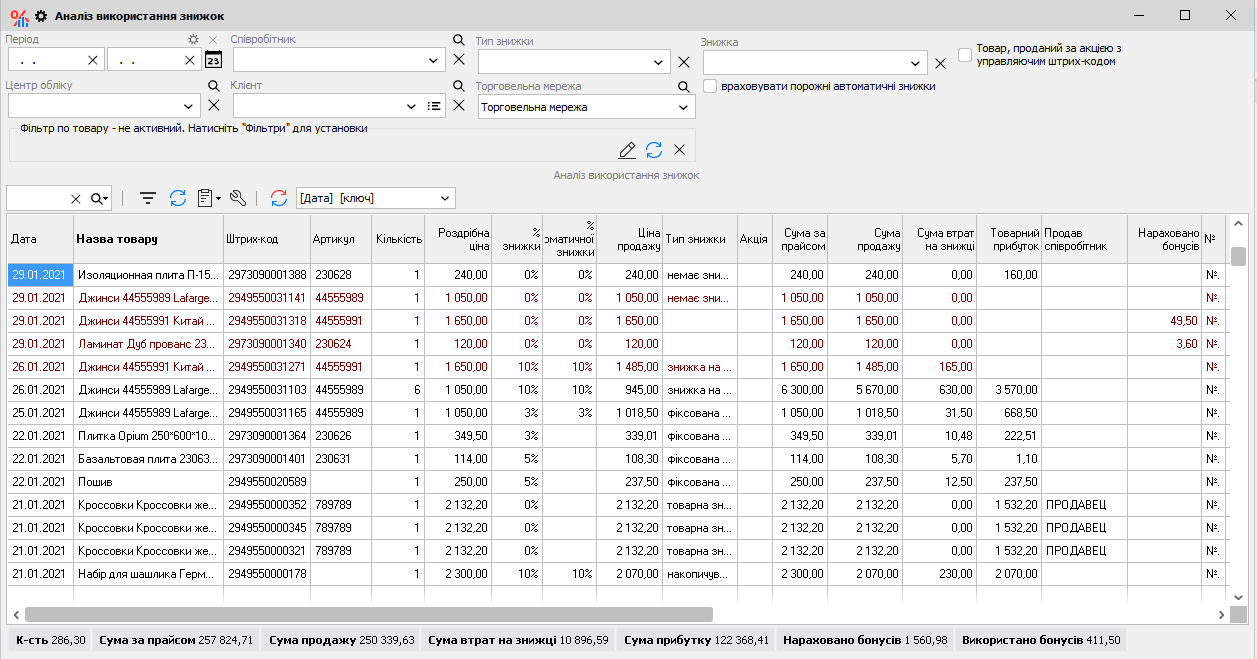
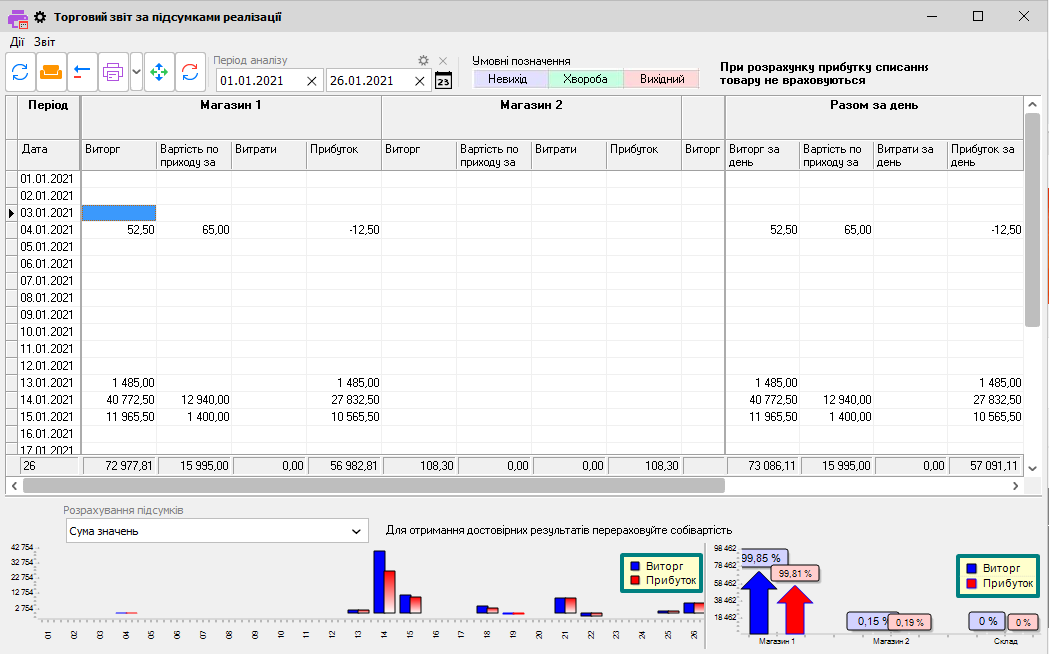
To prepare actual figures in Torgsoft, you can use «Оплата → Фінансовий документ» (“Payment → Financial document”): the documentation describes tracking cash register and bank account transactions, filtering by period, cash register, counterparty, and financial analysis item. Cash registers are created in «Налаштування → Каса» (“Settings → Cash register”), with an accounting center assigned and a currency selected. To reconcile a specific cash register, set it and the date range; currency filtering is also important for the relevant report totals. The documentation provides for creating an Excel document from the cash register documents list; you can use these data to update the forecast manually.
The day report from the «Реалізація» form (“Sales” form) includes amounts for cash and noncash sales, returns, other receipts, and expenses. Compare them with the cash register check and bank statement, especially when settlements from card sales arrive later. In financial documents, a transfer from a cash register to a bank account automatically creates a linked bank document: when preparing overall cash flow, account for both sides as an internal transfer. If a bank fee is entered in a payment document, the program creates an additional linked financial document for it, so check that the amount has not been duplicated in your spreadsheet.
To review purchases, use «Склад → Стан складу» (“Warehouse → Stock status”): the form shows the quantity, selling price, and cost of goods, lets you set a minimum stock level, and open an analysis of sales intensity. We recommend using these data to select items to replenish or reduce orders for, then entering payment dates and amounts in a separate 13-week forecast. The presence of goods in stock and their book value do not, by themselves, determine when sales money will arrive.
Weekly check for a store owner
- Reconcile balances. Confirm cash on hand and available bank funds, and check expected settlements and pending internal transfers separately.
- Explain variances. Compare last week’s plan with actual results: what changed because of sales, payment timing, returns, or new payments?
- Check upcoming payments. Make sure payroll, taxes, suppliers, and loans have amounts, dates, and a source of funds recorded.
- Update debts and purchases. Check overdue customer payments, orders already agreed, and stock levels before making new purchases.
- Recalculate all 13 weeks. Find the lowest balance in the regular and cautious scenarios and compare it with the reserve you chose.
- Record decisions. For each expected shortfall, define an action, responsible person, amount, and confirmation deadline. Once confirmed, update the relevant weeks in the forecast.


 Go back to the previous step