


Communities, Consultations, and Business Events for Store Owners in Ukraine
19.09.2026 10:00Store owners should choose a business community, consultation, or event to address a specific task: improving purchasing, understanding marketplace sales, strengthening teamwork, or discussing the challenges of running a business in Ukraine. First, define your question and prepare your own figures. Then check whether the audience, program, and access terms meet your needs.
Below, we compare six resources for Ukrainian entrepreneurs. They offer different formats: an industry association, a business association, a free consultation, training, or a closed professional community. Before paying, find out the full cost, what services are included, and how to end your participation. After a meeting, test the advice you choose on a small part of your store’s operations.

Professional group page: check the rules, topics, and latest discussions before participating.
Which resource to choose for your store’s needs
The table outlines each resource’s purpose and questions to ask its representatives. The order is intended to help compare formats; it does not indicate quality.
| Resource | Who might consider it, and why | How to join and what to check | Limitations |
|---|---|---|---|
| Retail Association of Ukraine — RAU | Owners and managers of retail companies seeking industry analysis, professional events, and representation of retail interests. | To become a member, a company signs a memorandum. Ask about admission criteria, fees, access to analysis, and any separate event charges. | According to RAU’s definition, its members are companies and brands that work only with end consumers and have signed a membership memorandum. Match the program of each event to your store’s size and format. |
| Union of Ukrainian Entrepreneurs — SUP | Entrepreneurs in various industries looking for a business community, committee participation, and representation of business interests. | Membership starts with a questionnaire and application review. Membership fees and a one-time joining fee apply; the Union confirms the final category. | The Union covers a range of industries. Ask which committees and work formats are relevant to retail specifically. |
| European Business Association — EBA | Owners and teams considering membership in a cross-industry association and wanting to assess its member companies. | The website has a company directory and a link to join. Ask about fees, the application process, employee access, and terms for the educational program you need. | Employee registration on the website is linked to company membership. A company’s presence in the directory does not mean it is ready to work with you. |
| Diia.Business | Entrepreneurs seeking an initial consultation about a specific business question. | Free online and in-person consultations are available by appointment. Check the topic, how to prepare, and available times. | This is a consultation format. Ask about the scope of any further support and whether a follow-up meeting is possible. |
| eCommerce Ukraine | Sellers looking for training on Etsy, eBay, Amazon, or their own website. | The website presents an online course marketplace. Check payment, access, and support terms in the description of the offer you choose. | A course catalog alone does not show how active participant discussions are or how useful responses in social groups may be. |
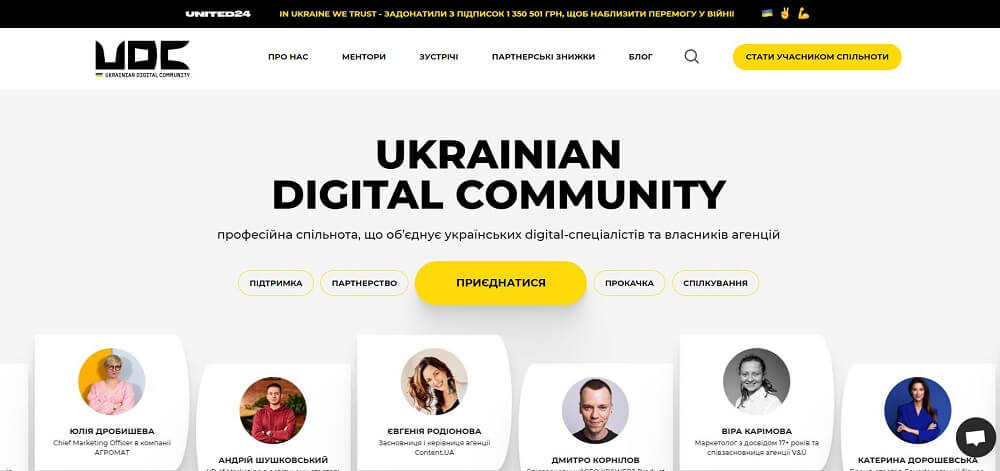
| Ukrainian Digital Community — UDC | Store owners who manage digital marketing themselves or are developing a marketing team. | A closed community with a paid subscription. Access to task reviews, mentoring, and other formats depends on the plan. | Its main audience is digital agency owners, managers, and specialists. For questions about checkout operations, purchasing, or inventory records, first check whether the topics are a good fit. |
What to find out before contacting each resource

Choose learning materials and discussions according to the needs of your online store.
RAU: retail industry topics
The Retail Association of Ukraine lists work with government, business media, market research, and professional online and in-person events for company owners and managers among its areas of focus. These areas are described on the official RAU page, and its membership definition appears in the section for member companies.
If you plan to expand your store network or review how your locations operate, send an association representative a short business description and a list of the topics you need. Ask which research, meetings, and participation opportunities are available under the proposed terms. For a small store, a single topic-specific event may be a suitable first step if the organizer allows individual participation.

Choose a group with clear moderation rules and useful topic-specific discussions.
SUP: representing business interests and cross-industry networking
The Union of Ukrainian Entrepreneurs brings together entrepreneurs regardless of the size, industry, or location of their business. Its stated priorities include protecting entrepreneurs and maintaining dialogue with government. This is described on the about SUP page. The membership application asks applicants to choose a membership category and committee, provide company details, and describe a problem they want to solve.
Before applying, write down what you expect from participation: discussing a shared industry problem, serving on a committee, or learning from entrepreneurs in other fields. Ask how submissions are handled, what review involves, and which work formats are available in your region. This will help you estimate how much time your store team can realistically devote to membership.

Example of an RAU page. Check the association’s official website for current participation terms and events.
EBA: assessing the association’s members and team access
The European Business Association directory lets you search for companies by business type, market segment, and other criteria. The page also explains that website registration is available to employees of member companies using their corporate email addresses. You can contact a company using the inquiry form in its profile.
If your goal is to train store managers or employees, first request details of the specific program: topics, required experience, practical exercises, access to materials, and total cost. Ask separately whether training is included in membership and whether nonmember companies can participate. Use the directory to assess the organization’s membership; judge the training by its program.
In digital marketing communities, choose discussions suited to a specific sales task.
Diia.Business: a free consultation for a specific question
Diia.Business offers free consultations online and in person. Its page includes categories, a list of experts, a consultation matching test, and links to entrepreneur support centers. Online consultations are available by appointment throughout Ukraine and run from 10:00 to 18:00 Kyiv time. Air raid alerts may affect meeting times and duration, so confirm the specific time when booking.
To prepare, describe the situation, the outcome you want, and what you have already tried. For example, the question “How do I decide which products to add to my online store first?” gives a consultant more context if you include summarized sales, inventory, and available budget figures. Before an in-person visit, confirm the address of the center, how appointments work, and what to do during an air raid alert.
eCommerce Ukraine: training for marketplaces and your own website
The official eCommerce Ukraine website presents an online course marketplace with categories for Etsy, Amazon, eBay, and website development. For a store owner, this is a reason to evaluate the specific course: what tasks it covers, what prior knowledge it requires, and how feedback is provided.
Before paying, request the syllabus and terms for accessing lessons. Ask whether assignments are reviewed and how materials are updated when a platform changes its rules. If you specifically want to talk with other sellers, ask separately whether a chat is included and who answers questions. Agree on the level of access needed to work with your store account; do not post passwords or verification codes in group discussions.
Ukrainian Digital Community: for managing digital marketing
Ukrainian Digital Community describes itself as a closed community for developing agencies, teams, and expertise in the digital field. It offers topic-based chats, meetings, task reviews, and mentoring, with access varying by subscription. A store owner might consider this format if they already have substantial digital marketing experience and manage a marketing team, hire contractors, or handle promotion themselves. The community website explains that its formats are intended for experienced specialists and managers, and recommends that beginners first complete training and gain practical experience.
Before joining, describe your level of experience and ask which formats would help with retail business needs specifically. Check what each plan includes and how long it lasts: the introductory “База” (Base) plan is available only once, lasts one month, and does not include closed task reviews, the mentoring program, or regular group meetings for agency owners. Task reviews are included in the three-month “Основа” (Foundation) plan, while the mentoring program and group meetings for agency owners are included in the annual “Ґрунт” (Groundwork) plan. After the first month, “База” automatically switches to the three-month “Основа” plan unless you cancel during that month. Confirm the date of the next charge, how to cancel, and separately whether refunds are available.
How to choose a business event and check the participation terms
Start your search in the RAU events calendar or the events section of the organization’s official website. A calendar may show both upcoming events and an archive, so open the page for the specific event and check the date, registration status, and final program.
For an initial screening, match the program to your question. If you want to reduce excess inventory, look for discussions of purchasing, assortment, and product records. A meeting about evaluating advertising spend may be a better fit for a marketing manager. Find out whether you can ask questions and receive materials for later use.
- Organizer and contracting party. Check the organizer’s name against its official website. Confirm who takes payment and provides the service, and check that the details on the invoice match the participation terms.
- Program. Check the topics, schedule, discussion format, and whether the program may change. Ask what practical materials participants will receive.
- Registration and access. Find out when registration is confirmed, how to get a ticket or link, whether you can substitute another participant, and how long a recording will be available.
- Accessibility. For in-person attendance, ask about step-free entry and movement around the venue. For an online event, check the technical requirements and whether captions or other support you need are available.
- Payment. Get the total amount due and a list of included services. Ask what documents the organizer will provide.
- Cancellation, rescheduling, and refunds. Read the terms for participant cancellation, date changes, and organizer cancellation. Keep a copy of the terms with your payment confirmation.
- Safety and shelter. Ask for the shelter’s address, the route to it, what to do during an air raid alert, and how the program will resume. Factor this into your travel plans.
How to assess a professional Facebook group
Before posting a question, review recent posts and discussions on your topic. Check the date of the latest substantive replies, advertising rules, how to contact moderators, and how they respond to spam. Compare how many posts receive useful answers with how many simply promote paid services without explaining the approach.
Assess several replies to difficult questions: do participants ask about the store’s circumstances, cite sources, and explain the limits of their experience? An old screenshot or a high follower count does not tell you enough about a group’s current value. Start with a focused question that contains no confidential information, then check the substance of the recommendations you receive.
How to prepare, take part in a meeting, and test the advice
Before participating: prepare your question and figures
- Choose one task. Phrase the question so the answer can help you make a decision. For example: “How should I change orders for this product category if some of the assortment stays in stock for a long time?”
- Prepare a brief description of the situation. Include your store format, product category, observation period, sales, returns, inventory, and budget constraints. Explain what changes you have already tried.
- Prepare anonymized data. Use summaries by product or customer group for discussion. Remove names, phone numbers, addresses, card numbers, and other details that could identify a customer.
- Decide what you want from the meeting. Write down the outcome you are looking for: a list of possible solutions, a calculation method, or a plan for a limited trial.
During the meeting: clarify when the advice applies
When someone describes an approach that worked, ask about their business format, product category, length of the trial, and costs included. If they recommend changing purchasing or discounts, ask how they accounted for inventory, returns, and changes in demand. Write down the action, the conditions for applying it, and the measure you can use to evaluate the result.
Check tax, employment, and other legal advice for a store in Ukraine against Ukrainian official sources. Ask for a link to the specific legal act and article, and clarify the scope, exceptions, and temporary provisions, including those related to martial law if relevant. For decisions with financial consequences, give the materials to an accountant or lawyer along with a description of your situation.
After the meeting: run a limited trial
Choose one action for one product category or store location. Before you start, assign an employee to oversee it, set a budget and timeframe, and decide when to stop the trial. Record the baseline figures, then compare sales, returns, inventory, and costs across comparable periods. Account for price, advertising, and product availability changes, as these may also affect the outcome.
For example, you could test advice to order a product in smaller batches more often in one category. The owner records inventory and sales, agrees on a schedule with the supplier, and tracks delivery costs and stockouts. After the trial, they decide whether to continue, change the terms, or return to the previous approach.
How to calculate the cost of attending a business event
Include the ticket, travel, accommodation if needed, staff cover, and an agreed estimate of the work time spent in your participation budget. Also budget separately for testing the idea you take away. This will help you compare the full cost with the actual result of applying it.
Illustrative calculation. Suppose attending the event and testing an idea cost 6,000 UAH in total. If each additional order contributes 300 UAH after the cost of goods and all variable expenses, you need 20 additional orders to cover the 6,000 UAH: 6,000 ÷ 300 = 20. This calculation assumes fixed costs remain unchanged and returns are accounted for in the 300 UAH. Use it as a guide; establish the actual number of additional orders after the trial.
How to prepare store data and check changes in Torgsoft
Before a consultation, prepare sales for the period you selected and inventory for the relevant category. According to the official documentation, the “Реалізація” (“Sales”) mode provides daily reports and a product report by period. “Стан складу” (“Warehouse status”) shows product quantity, price, and cost and lets you view quantities as of a specified date. Select the relevant warehouses and use the same period boundaries so the figures you share are consistent.
For questions about repeat purchases, use “Аналіз активності покупців” (“Customer activity analysis”): set the period and accounting center, then review the number of purchases and sales amounts. If you leave these fields blank, the analysis covers the full history of recorded transactions and the whole retail network. How complete the findings are depends on whether sales are linked to customers. The sales revenue figure in this analysis does not account for returns. Prepare summarized results for discussion without customers’ personal data.
After testing the advice, run the same reports with the same filters and compare them with your baseline data. Include participation, delivery, advertising, and other change-related expenses in your own outcome calculation. If you are testing a minimum stock rule, first set the minimum quantity in “Стан складу” (“Warehouse status”), then use the relevant filter for products that are running low. Record your decision and the date for the next review of the figures.
-
08.10.2026
42 Retail Promotion Ideas and Examples

42 retail promotion ideas: discounts, bonuses, gifts and loyalty programs. Practical examples, marketing advice and Torgsoft features.
-
04.10.2026
How to Decorate a Store for Halloween and Boost Sales
Halloween window display ideas, safety rules, modern retail sales practices, and how to set up promotions, mailings and analytics in Torgsoft.
-
19.09.2026
Online Gifts for Your Store: 9 Formats and How to Launch
How to sell gifts online: choose formats, calculate costs, arrange delivery to someone else, and set return terms.



 Go back to the previous step