


To choose Ukrainian footwear for your store, first define the categories, sizes, and purchasing budget you need, then compare specific styles from several suppliers. Ask for the material composition, size charts, manufacturer and country-of-origin details, price list, and written terms of cooperation. A trial order can help you assess fit, demand, and costs before placing the next order.
This guide covers 14 brands and retailers with different assortments, from city shoes and sneakers to tactical and work footwear. Take each company’s business model into account: a factory, a footwear brand, and a retail chain have different supply capabilities. The fact that an item is available in a Ukrainian store does not by itself confirm that the specific pair was made in Ukraine.
- How to compare footwear before placing an order
- 14 brands and retailers to include in your comparison
- How to verify that a specific style is made in Ukraine
- How to plan a trial order and assess its results
- How to agree on exchanges, warranties, and customer claims
- Tracking footwear in Torgsoft: styles, sizes, colors, and stock
- Official sources for checking the assortment
- Automated with Torgsoft
How to compare footwear before placing an order
We recommend creating one comparison table for all candidates. Each row should represent a specific style with a defined material and lining. If boots with the same name come in summer and insulated versions, list them separately: the purchase price, fit, and selling season may differ.
| What to compare | What to request or check | Why it matters to the store |
|---|---|---|
| Intended use | City wear, everyday wear, hiking, work; limitations stated by the manufacturer | So sales staff can recommend a pair that matches the customer’s needs |
| Upper, lining, sole | Composition of each component, insulation material, care instructions | To compare like-for-like styles and describe products accurately |
| Last and sizes | Size chart for the specific style, explanation of measurements, available width options | To select the size range and reduce sizing mistakes during customer consultations |
| Origin | Manufacturer, country of manufacture, sample labeling, and accompanying documents | To substantiate the origin of each item |
| Supply | Minimum order, required size run, lead times, and the ability to reorder | To estimate the required budget and risk of unsold stock |
| Price and returns | Wholesale price list, payment terms, delivery, and procedures for defects and unsold pairs | To calculate costs and agree on the parties’ responsibilities |
Clarify what a measurement in centimeters on a supplier’s chart refers to: foot length or insole length. For a fitting, we recommend measuring both feet, giving the consultant the larger measurement and the width, and trying on the pair with a sock of the intended thickness. Ask what allowance is recommended for that last. The single rule “buy one size larger” should not be applied to the entire assortment.
Compare materials component by component as well. For fabric inserts, ask for the name and composition; for insulation, ask for the exact material; and for a mixed-material upper, request a list of its components. A description of water-resistant fabric does not provide enough information about the whole shoe construction: ask separately about the properties of the seams, tongue, and sole attachment. Include only confirmed characteristics of the relevant item in your store listing.
14 brands and retailers to include in your comparison
MIDA
The Zaporizhzhia footwear factory describes on its official page its production of men’s and women’s footwear for customers with average incomes and its use of natural materials. Products are sold through branded stores and partners. For a store with an everyday assortment, this makes it possible to consider both categories from one manufacturer; the selection should reflect demand for men’s and women’s styles. Some brand stores use Torgsoft for inventory management. For an initial comparison, we recommend requesting a selection of men’s and women’s styles from the same season and comparing purchase prices, available sizes, and repeat-supply terms.

IKOS
On its own website, the manufacturer says it makes footwear in Lutsk, selects natural leather, and adjusts lasts to foot measurements. Its collections include loafers, oxfords, Chelsea boots, pumps, Mary Janes, mules, cowboy boots, and ankle boots. This range is worth considering for a city assortment with classic and everyday styles. Since toe shapes and heels vary, the results of fitting one pair should be applied only to the same last. Before ordering, we recommend asking the supplier to identify which selected styles share a last and to provide size charts for each group.

KADAR
The company presents itself as a manufacturing partner for retail chains and brands, with its own factory in Ukraine and experience making leather footwear. This positioning may be relevant to a business owner looking for a production contractor. In your inquiry, describe the type of cooperation you need: purchasing ready-made styles or manufacturing under your own brand. Before paying, we recommend getting written confirmation from the company of the available cooperation format, minimum order quantity, and whether the construction can be modified. If you need private-label manufacturing, separately agree on the sample requirements, approval process, labeling, and delivery times.

Bastion
The Kharkiv manufacturer states on its store website that the brand has operated since 1997 and specializes in leather footwear for a wide range of customers. Its men’s and women’s assortment covers different seasons; key categories include shoes, sneakers, and boots. The site offers retail purchases directly from the manufacturer. A store owner should therefore negotiate resale supply separately: retail promotions, delivery, and extended return periods do not by themselves establish wholesale terms. We recommend requesting a separate commercial offer with purchase prices, minimum pair quantity, available sizes, and the procedure for returning products with manufacturing defects.

M-Tac
The Ukrainian brand offers tactical footwear, including Coyote mid-season sneakers. Its official product listing specifies a suede and Cordura fabric upper, a membrane lining, a two-component sole, rubberized toe and heel, and extended lacing. You can use these details in the description of the specific item; they do not characterize the entire collection. The brand’s Ukrainian origin also does not confirm the country of manufacture of every pair. Stores selling this brand’s footwear use Torgsoft. For a trial order, we recommend requesting the size chart for these sneakers specifically, a list of available sizes, and confirmation of the country of manufacture, then checking the received sample’s labeling against the listed characteristics.

Stimul
On its official website, the company presents itself as a manufacturer of tactical footwear. Its catalog includes sneakers, combat boots, high-top and tactical boots, as well as women’s styles; clothing and equipment are listed separately. This lets a specialist store source products in several categories from one supplier. If a customer needs footwear for occupational protection, the seller needs confirmation of the relevant properties for the specific style: the word “tactical” alone does not specify a level of protection or suitability for particular working conditions. Before ordering, we recommend sending the supplier a description of the intended conditions of use and asking which styles meet the request and what documents substantiate their properties.

Ultera.Tech
According to the manufacturer’s information, the footwear is handmade in Kharkiv. Some sneakers are listed with Nappa leather, water-resistant Cordura fabric, and a sole made of ethylene-vinyl acetate, identified as EVA; the catalog also includes insulated versions. The stated property of the fabric does not confirm that the whole pair is waterproof, so sellers should reproduce the description of the specific construction accurately. The brand states that it provides a one-year warranty; obtain the full terms of its application before relying on this promise in your store. We recommend confirming in writing which styles the warranty covers, who handles customer claims, what documents are required, and how the supplier will work with your store when claims are reviewed.

OMG Shoes
The footwear range appears on the brand website alongside clothing and bags. Visible categories include shoes and slingbacks—styles with a strap behind the heel. This assortment is worth considering for a selection of women’s shoes, with attention to heel hold and whether the strap can be adjusted. Before ordering, we recommend confirming in writing with the company where the selected styles are made and whether it supplies products for resale. If your store needs custom-made footwear, first confirm that this service is available and establish its terms. For a trial order, also request size charts and material descriptions for each pair.

MERLE
The manufacturer positions its footwear as anatomical; some pairs carry the barefoot label, used for footwear designed to support more natural foot movement. The catalog includes ballet flats, shoes, sneakers, trainers, sandals, loafers, and boots, including insulated leather and suede styles. During a customer consultation, explain the construction of the specific pair: toe shape, sole, and insole. Anatomical positioning does not justify promising treatment or replacement of an orthopedic device prescribed by a doctor. For comparison, we recommend requesting samples of selected styles and checking the available toe room, foot hold, and whether the actual measurements match the supplier’s size chart.
Kohani
On its official page, the brand says it has its own Ukrainian production, uses handwork by artisans, and works with natural leather. The catalog has men’s and women’s sections, so it is worth considering for both areas of a store. You can use this information in product presentations with a link to the manufacturer, while describing composition and production method based on the specific item. The fact that a pair is handmade does not determine its fit or service life, so consultations should be based on its characteristics. For comparison, we recommend requesting styles for the required season from both the men’s and women’s sections, then checking lining materials, available sizes, and the ability to reorder.
te.shoes
The website lists shoes, sneakers, summer footwear, boots, and a men’s section. Specific styles include tall boots, hikers, clogs, and mules, while sneakers are offered for women and men. This selection can expand a city assortment with styles of different heights and constructions. The term “hikers” by itself does not confirm suitability for hiking: selling them for that use requires information about the specific pair and the manufacturer’s stated conditions of use. For a city assortment, we recommend comparing selected styles by height, fastening, and materials, then confirming wholesale availability and the sizes in stock before ordering.

SEZON
The retail chain and online store sell footwear, clothing, and accessories. The footwear catalog covers trainers, sneakers, moccasins, shoes, boots, sandals, and tall boots. The chain works with Ukrainian and foreign manufacturers, so the origin should be checked for each specific pair. For a store owner, the catalog can serve as a reference for the categories on offer; wholesale availability requires separate confirmation. The chain has used Torgsoft since 2016, as stated on its customer page. We recommend comparing specific items with manufacturers’ offers and asking about separate resale terms, since a retail price and listing availability do not confirm wholesale supply.

Talan
The company traces its history to 1923 and presents work footwear, tactical boots, and hiking boots, including natural leather styles, on its official website. For orders delivered within Ukraine, the site directs customers to the Workwell store, so place Ukrainian orders through it. If a store is sourcing footwear for a business, start the selection with the required protective properties and the documents that confirm them for the relevant item. We recommend sending the seller a list of working conditions, required sizes, and pair quantities, then agreeing on the suitable style, delivery times, and process for handling discrepancies before payment.
Babylon
According to the brand’s own description, its footwear has been handmade at a family factory in Kharkiv since 1997, with a separate last developed for each style. The men’s and women’s assortment includes sneakers, trainers, boots, UGG-style boots, loafers, and sandals. The press page lists natural leather, nubuck, suede, sheepskin, and felt among the materials. Since lasts vary, select sizes using the chart for the specific style, especially for insulated pairs. For a trial order, we recommend comparing low-top and high-top sneakers, boots, and UGG-style boots separately by lining material, available sizes, and the ability to reorder the specific item.
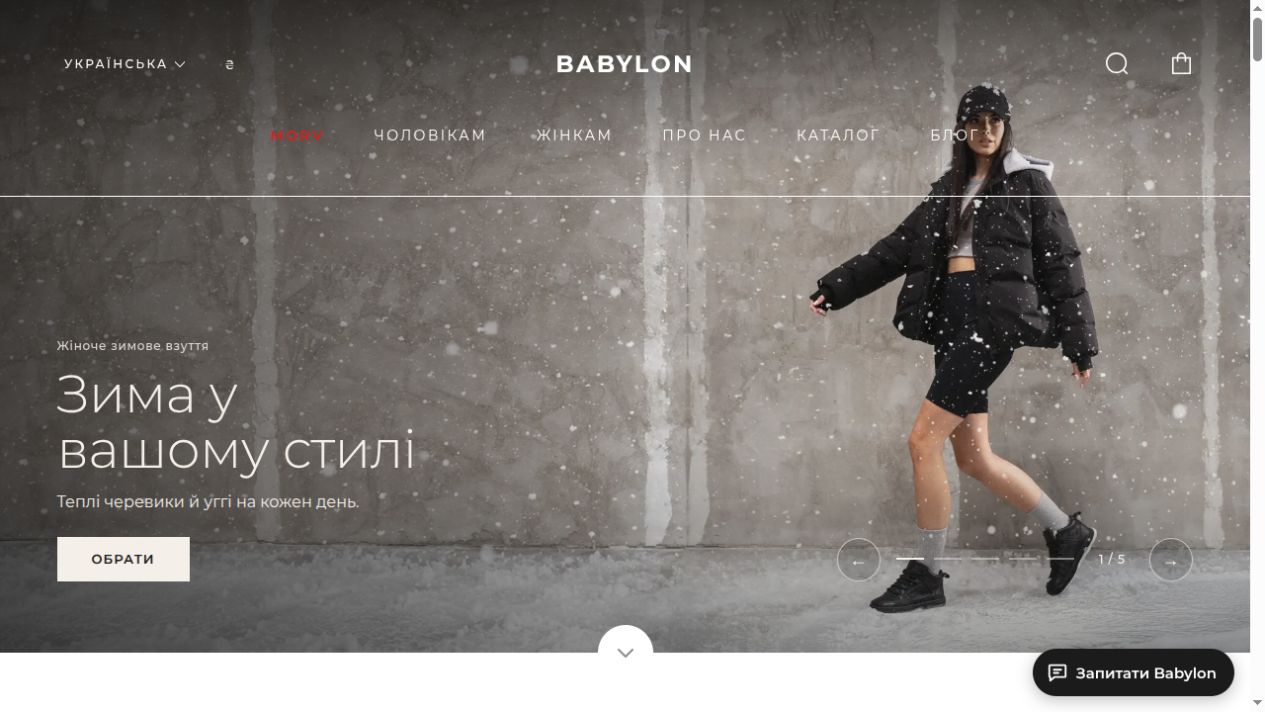
Screenshot of the Ukrainian version of the Babylon website.
How to verify that a specific style is made in Ukraine
If origin is a condition of purchase, we recommend agreeing on it in writing before payment. Confirmation that a company has its own factory describes the company, but your order needs details for the selected items.
- Send the supplier a list of styles, including colors and seasonal versions. Ask them to specify the manufacturer and country of manufacture for each item.
- Request photos of the labeling on the footwear and box, along with the relevant accompanying documents. Compare them with the product listings.
- Agree on how the supplier will notify you of changes to the production site, material, or construction for repeat orders.
- On receipt, check the delivered batch against the agreed details. If information conflicts, ask for a written explanation before putting the products on sale.
- Keep the confirmation with your purchasing documents so sales staff can use verified details in customer consultations.
How to plan a trial order and assess its results
We recommend starting with a small selection based on a clear customer need. For a city footwear store, this might include sneakers, everyday boots, and shoes. Before ordering, record the number of inquiries for each category, required sizes, and a price customers are likely to accept. Send each supplier the same request: wholesale price list, validity period, minimum order, ability to select sizes, advance payment, delivery, reorders, and procedures for handling discrepancies.
Illustrative trial order: three styles in two colors and four sizes, one pair of each variant, equals 3 × 2 × 4 = 24 pairs. At an assumed purchase price of 1,800 UAH per pair, the goods will cost 43,200 UAH. This structure works only if the supplier allows size selection and all variants match store demand. If the budget is smaller, we recommend reducing the number of styles or colors after reviewing customer inquiries.
Agree on an evaluation period for the order upfront. Each week, record sales, remaining stock, requests for unavailable sizes, and the reasons for declined purchases and returns. If a style sells slowly, check whether enough customers try it on, whether the size chart matches the actual fit, and whether sales staff explain the materials clearly. Base the reorder decision on the results for each specific style and size.
Illustrative calculation: a store bought a pair for 1,800 UAH and sold it for 2,700 UAH. The difference is 900 UAH. If delivery cost 60 UAH per pair, packaging cost 20 UAH, and the payment fee was 54 UAH, 766 UAH remains after those expenses. Taxes, rent, payroll, and other expenses still need to be covered from that amount. Unsold pairs remain in stock, so also assess the entire purchase by the amount of money tied up in remaining inventory.
How to agree on exchanges, warranties, and customer claims
For retail sales in Ukraine, follow Ukrainian consumer protection law. We recommend separately agreeing with the supplier in the contract on returns of unsold stock, deadlines for reporting defects, the quality-check procedure, and shipping costs. Consumer exchange rules should not be applied to a wholesale purchase for resale unless the contract provides for them.
Under Article 9 of the Law of Ukraine “On Consumer Rights Protection” No. 1023-XII, a consumer has the right to exchange a non-food product of proper quality for a similar one from the seller from whom it was purchased if the product did not fit in shape, dimensions, style, color, or size, or for other reasons cannot be used for its intended purpose. The exchange period is 14 days, excluding the day of purchase, unless the seller has announced a longer period.
The product must be unused, with its appearance, consumer properties, seals, and labels preserved; the buyer must present the payment document required by law, in paper or electronic form. If a similar product is unavailable, the buyer may choose another product with a price adjustment, terminate the contract and get a refund, or wait for a similar product. The seller must notify the buyer on the day that product arrives.
When the contract is terminated, the refund is based on the product’s price at the time of purchase. The money must be refunded on the day of termination; only if that is impossible may the parties agree on another period, which must not exceed seven days.
Handle claims about defects under Article 8 of this Law. If the buyer discovers defects during the warranty period, they may request a proportionate price reduction, free repair, or reimbursement of the cost of repairing the defects. If the buyer requests free repair, the defects must be remedied within 14 days of the request unless the parties agree on another period. If a substantial defect caused by the manufacturer or seller is discovered during the warranty period, or the product is found to be counterfeit during that period, with an expert assessment confirming the finding where necessary, the buyer may choose to request a replacement or terminate the contract and get a refund.
If the contract is terminated because of product defects, the refund is based on the product’s value when the claim is made if the price has increased, or at the time of purchase if it has decreased. The money must be refunded on the day the contract is terminated; if that is impossible, the parties may agree on another period of no more than seven days.
The seller must accept a product of improper quality. The buyer has the right to take part in the quality inspection in person or through a representative. A claim must be rejected if the seller or manufacturer proves that the defects arose because the buyer failed to follow the rules for use or storage. To pursue a claim, the buyer presents a payment document and, for a product with a warranty period, a technical passport or equivalent document marked with the sale date.
We recommend recording the style, description of the defect, and remedy chosen by the buyer.
Under Article 15 of this Law, buyers must receive necessary and reliable information before purchasing a product. Prepare verified information for sales staff on footwear properties, price, use, care, warranty, and claim handling. Before selling seasonal footwear, check the procedure under Ukrainian law for determining when the warranty period begins, and prepare an explanation for customers. Check brand terms for compliance with the law before using them in your store’s policies.
Tracking footwear in Torgsoft: styles, sizes, colors, and stock
For a trial order, we recommend tracking each combination of style, color, and size as a separate inventory item. Torgsoft supports data for item code, material, color, size, manufacturer, and supplier; size-based products can have separate barcodes. In the “Стан складу” (“Warehouse status”) mode, you can view quantity, size, price, cost, and discount, and filter products by manufacturer, supplier, season, and other characteristics. The accuracy of these filters depends on how staff filled out the product records when receiving the goods.
Before reordering, check stock by required size and product movement; before applying a discount, check its effect on the amount above cost. The documentation describes viewing price and discount history, analyzing sales velocity, and tracking inventory turnover. Check which features are available under your license: Torgsoft Start and Torgsoft Ultra have different feature sets. Start is designed for one accounting center; Ultra supports multiple centers, transfers, and supplier orders. For local operation, each computer requires a separate license of the relevant type.
If stores at different locations use a shared server database, consider a paid terminal license or Torgsoft Online subscription. The terminal license includes three client connections; additional connections are paid separately. With Torgsoft Online, the program and database are hosted on Torgsoft’s server, and access is available for the paid period. Once payment is confirmed, Torgsoft provides an electronic key or access to program activation.
For a new client, the standard implementation package includes two hours of remote setup assistance and consultations, which can be used during the first 30 days; subsequent service is paid separately. Check the support included in the selected plan, current prices, and activation terms in the licensing terms and agree on them before payment. Online store synchronization and minimum and maximum stock levels by warehouse require full functionality and separately paid options; they are unavailable in Torgsoft Start.
Before payment, we recommend agreeing with Torgsoft on how to activate these options, the required settings, and the full configuration cost. Check the selected configuration with your own workflow: receive footwear by size, sell and return a pair, review stock, and prepare the next order.
Official sources for checking the assortment
MIDA, IKOS, KADAR, Bastion, M-Tac, Stimul, Ultera.Tech, OMG Shoes, MERLE, Kohani, te.shoes, SEZON, Talan, Babylon.
Automated with Torgsoft


 Go back to the previous step