



Handing orders over to a fulfillment operator makes sense when its total cost and service quality meet the store’s needs. To decide, compare costs over the same period, check your in-house warehouse capacity, and run a one-week pilot. The order volume at which outsourcing becomes worthwhile depends on your costs and the operator’s terms.
Before handing over all your goods, agree on the list of services, receiving rules, dispatch times, reporting, and responsibility for discrepancies. The store needs a defined process for checking stock levels, picking errors, and returns.
What store fulfillment includes
Fulfillment means having an outside operator handle warehouse operations for the store’s orders. The operator receives and stores goods, picks the required items, packs them, and hands parcels to the carrier. Returns processing is included only to the extent agreed.
Specify who checks returned goods, photographs damage, decides whether an item can be resold, and informs the store. Payment collection, customer communication, extra labeling, and special packaging also need to be agreed separately.
How to compare the cost of an in-house warehouse and fulfillment
Choose the same period, such as one month, and define the unit for comparison. For the calculation below, one order means one parcel dispatched with an agreed set of goods. If an order has several parcels or many items, find out how this affects the charge.
For your in-house warehouse, collect rent, payroll, utilities, equipment, packaging materials, and returns-processing costs. Include the owner’s time if they pick orders. Ask the operator for a full cost breakdown: receiving, storage, picking, packing, materials, returns, minimum charge, and additional work.
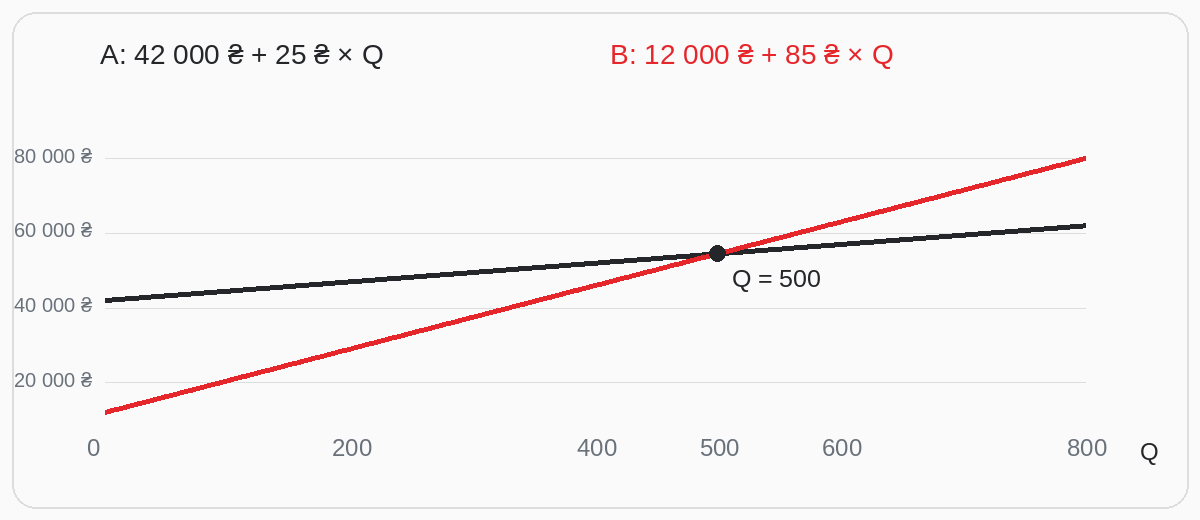
Illustrative example. The in-house warehouse costs UAH 42,000 per month plus UAH 25 per order. Fulfillment costs UAH 12,000 per month plus UAH 85 per order. These are assumptions for the calculation, not rates from a specific operator. Packaging and routine warehouse operations are already included in the respective amounts; do not add them again.
| Orders per month | In-house warehouse, UAH | Per order, UAH | Fulfillment, UAH | Per order, UAH |
|---|---|---|---|---|
| 400 | 52 000 | 130 | 46 000 | 115 |
| 500 | 54 500 | 109 | 54 500 | 109 |
| 800 | 62 000 | 77.50 | 80 000 | 100 |
Formulas: in-house warehouse = 42,000 + 25 × number of orders; fulfillment = 12,000 + 85 × number of orders. Costs are equal at 500 orders: (42,000 − 12,000) ÷ (85 − 25). At 400 orders, fulfillment costs UAH 6,000 less; at 800, the in-house warehouse costs UAH 18,000 less.
Delivery to the buyer is excluded from the table on the assumption that its cost is the same in both options. If the rates differ, add delivery to each calculation. Calculate setup costs separately: moving stock, labeling, and configuring data exchange. Check whether this work is already included in the proposal.
The calculation for 800 orders is valid if the in-house warehouse has enough floor space, storage locations, and working hours. Overtime, an additional employee, or expanding the premises will change the result. Include any costs that remain after handover in the fulfillment estimate as well.
How to assess the difference in warehouse costs
In this illustrative example, switching to fulfillment for 400 orders reduces the included monthly costs by UAH 6,000. At 800 orders, the in-house warehouse is cheaper by UAH 18,000 if it has enough capacity and there are no additional costs. These figures show the difference in warehouse costs under the stated assumptions. To make a final decision, add setup costs and the store’s costs that remain after handover, without counting any item twice.
What to agree on before handing over goods
Prepare a list of stock items, or SKUs. Each size, color, or other variant must be uniquely identified by a product code and barcode. Add the name, unit of measure, quantity, and storage and packaging requirements.
- Receiving. Agree on item-by-item counts, how damage will be recorded, a document showing the actual quantity received, and the deadline for reporting discrepancies.
- Dispatch. Set a cutoff time for same-day dispatch, and define how weekends and peak periods will be handled.
- Picking. Set the rule: no product substitutions without the store’s approval. For an unavailable item, name the person responsible and set a response time.
- Stock levels. Agree on reports for available, reserved, and damaged goods, as well as returns. Check accuracy by comparing the physical and recorded quantities for each item checked.
- Returns. Request the reason, photos of the item’s condition and packaging, and a separate status until a decision is made about resale.
- Responsibility. Clarify the terms for compensation for losses and damage, the claims process, liability limits, how the cooperation can end, and how stock will be removed.
These are recommended operating terms. Agree on them in writing with the operator to suit your assortment.
How to run a one-week fulfillment pilot
Hand over a limited batch and part of your real order flow. Include different product variants, an order with several items, and special packaging. Check exceptions: cancellations, an unavailable item, damage, and returns. If any of these do not occur during the week, agree on a test of those scenarios.
Each day, reconcile the orders handed over, actual dispatches, timings, and stock levels. At the end of the week, compare the invoice with the agreed estimate, check for errors, and carry out a sample stock count. After that, schedule weekly checks of higher-risk items. Begin the full handover once discrepancies have been resolved and the operator has confirmed readiness for the expected workload.
Stock accounting and goods transfers in Torgsoft
In Torgsoft, stocktaking lets you compare the actual quantity of goods with the recorded stock balance. You can enter the count by scanning or manually. To check a batch before handover, use the stocktaking instructions (інструкція з інвентаризації).
Transfers between accounting centers are recorded as internal transfers. Goods-in-transit accounting lets you show goods in the recipient’s stock balance after they are received. The process is described in the internal transfer instructions (інструкція з внутрішньої передачі).
Agree separately on the operator’s warehouse accounting setup and data exchange. Define the formats for orders, dispatch confirmations, stock levels, and returns, the transfer frequency, and who is responsible for errors. Integration with a specific operator needs to be checked and agreed separately.


 Go back to the previous step